
The KombiHaft Project Improves the Paintability of Polyolefin Surfaces
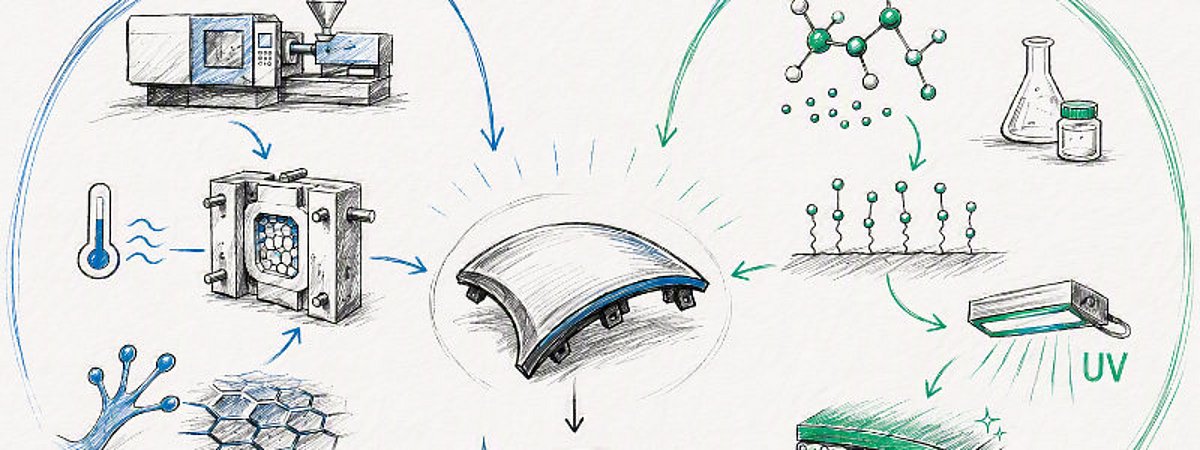
As part of the “KombiHaft” research project, SKZ and Fraunhofer IFAM are developing new processes for plastic surfaces that are easy to paint. The goal is to improve the paintability of polyolefins directly during the injection molding process.
Polyolefins such as polypropylene and polyethylene are indispensable in industrial production due to their mechanical properties, their low cost, and their comparatively good carbon footprint. However, their nonpolar surfaces pose a significant obstacle for subsequent painting and coating processes. This is precisely where “KombiHaft” comes into play. At Fraunhofer IFAM, photoreactive adhesion promoters are being developed that selectively accumulate on the component surface during the injection molding process. Subsequent UV activation permanently fixes these in the form of molecularly thin layers, enabling improved paintability without the need for additional wet chemical or thermal pretreatment.
Paintable polyolefin surfaces straight from the injection molding process
In parallel, SKZ is developing mold design strategies that specifically influence the boundary layer structure of the component. These include concepts for active and passive surface temperature control as well as biomimetic-inspired microstructuring of the mold surface. The goal is to establish the necessary surface functionality already during the molding process. This could eliminate the need for time-consuming process steps such as flame treatment, plasma activation, or primer application in the future. In addition to lower costs and shorter lead times, the project partners expect benefits in terms of process stability, scrap reduction, and sustainability. The approach could also be applied to bonding, printing, and multicomponent processes.
Contact details and information on the companies and institutions presented here can be found in our interactive surface technology industry directory.