
Dürr presents energy-flexible dryers for automotive painting
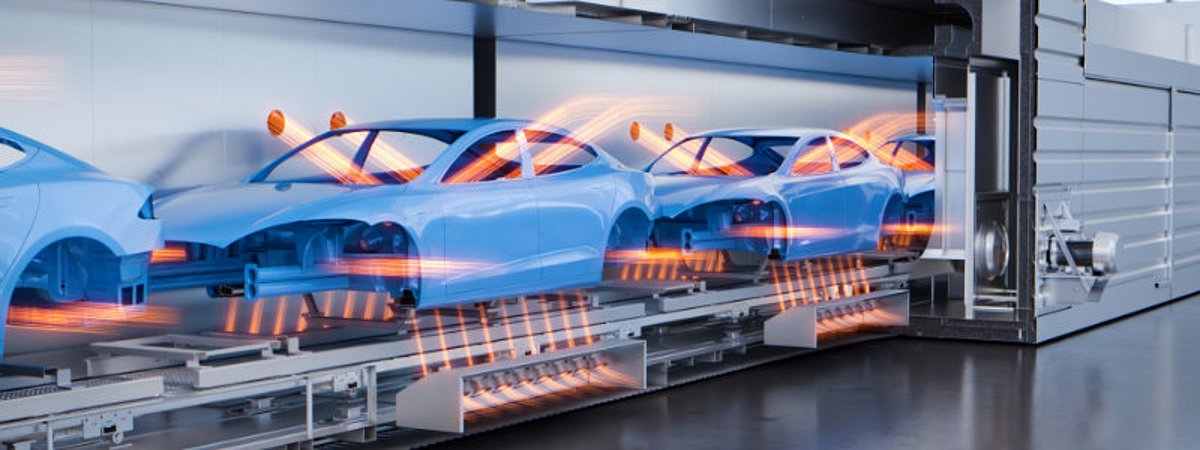
With its Qflex technology, Dürr is presenting a new concept that enables all dryers to be completely decoupled from the heat source. This allows car manufacturers to use different types of energy for paint drying.
Until now, dryers in automotive painting have always been designed for a specific type of heating. Fluctuating energy prices, uncertain availability and ambitious CO₂ targets are increasing the pressure to design these systems more flexibly.Dürr is therefore fully equipping its dryer portfolio with central heating technology and will focus on two energy-flexible systems in future: the EcoInCure and the EcoSmartCure with Qflex technology. Whether natural gas, electrical energy or, in future, hydrogen - the dryers' variable heating circuit can be operated with all relevant heat sources. This energy flexibility means that the system operator is no longer tied to a specific type of energy, which is determined by the choice of dryer type. "Nobody can predict today which form of energy will be available tomorrow without restrictions and at low cost," says Dr. Heiko Dieter, Product Manager at Dürr, explaining the advantages of the new concept. "If gas, for example, becomes unavailable at short notice, there is a risk of high costs or even production interruptions. Energy-flexible dryers then guarantee an alternative supply: If one energy source is not economical, operators can switch to another with little effort - without interfering with the structural substance of the dryer. Choosing a hybrid system also makes it possible to automatically switch to the most favorable energy source depending on the time of day."
Qflex technology as the technological basis
The core of the concept is a central heating module that generates the heat for the car body drying process and feeds it into the individual zones as required via a heating circuit. The separate heating module can be operated with gas or electricity. If an operator wants to change the form of energy at a later date - for example, because he is installing his own solar system - the dryer remains unchanged during the changeover; only the heating module is adapted. Innovative future technologies such as electrical high-temperature storage for the temporal decoupling of renewable energy generation and use can also be easily integrated with Qflex technology. The EcoInCure cross dryer, which has proven itself in more than 30 coating systems worldwide, meets the highest requirements in terms of heating dynamics, process reliability and coating quality. The EcoSmartCure is a new development in classic longitudinal operation. The innovative feature: it combines the central heating concept with the stop-and-go principle, in which the body passes through defined standstill phases. Compared to conventional dryers, this mode of operation enables much more precise temperature control: the body is heated specifically where it is needed instead of being exposed to air over a large area. This reduces thermal stresses, particularly in the case of solid components such as the sills of electric vehicles, and improves the paint quality.
Compact dryer design
Both dryers are compact single-level systems that do not require an additional unit level. Thanks to their small footprint, they can be easily integrated into existing buildings. EcoInCure and EcoSmartCure are therefore also an economically advantageous solution for brownfield modernizations - both in terms of CAPEX and OPEX. EcoSmartCure is currently being tested for industrial use. "The high level of customer interest and two ongoing projects confirm that we have hit a nerve with this new development," says Dieter. "Energy flexibility is no longer a dream of the future. Today, the Qflex technology in our dryers offers a solution for reacting flexibly to volatile energy markets and changing conditions in automotive production."
Contact details and information on the companies and institutions presented here can be found in our interactive surface technology industry directory.