
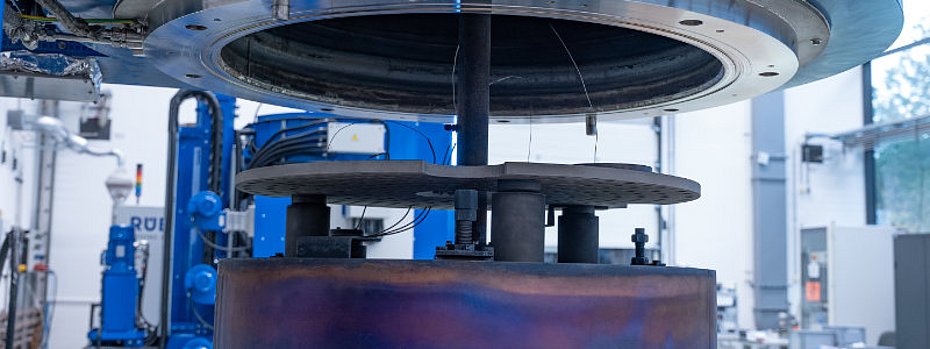
Thermal and thermochemical surface treatments are important processes in industrial manufacturing. They make tools and components, for example, harder and more resistant to wear and fatigue, and can improve their corrosion resistance; however, these processes are also very energy-intensive. The new collaborative project “CyPro — Cyber-Physical Production Systems for Improving Energy Efficiency and Ensuring Quality in Thermal and Thermochemical Treatment Processes,” which is coordinated by the Fraunhofer Institute for Thin Film and Surface Technology IST and began on July 1, 2026.
Considering Energy Consumption and Component Quality Together
A particular challenge in thermal and thermochemical treatment processes is that process parameters, energy consumption, and component quality are closely interlinked. Reducing energy consumption must not come at the expense of the required component properties. The “CyPro” project addresses precisely this intersection. The goal is to develop a cyber-physical production system (CPPS) designed to continuously collect and correlate process, energy, sensor, and production data. In addition, the use of optical emission spectroscopy is planned, among other methods, to monitor the state of the plasma in real time.
Based on the collected data, interpretable AI models will be developed to map the relationships between process parameters, energy requirements, and quality characteristics. The plan is to take into account, for example, the nitriding hardening depth, the formation of the intermetallic layer, or the corrosion resistance of the treated components. In contrast to purely data-driven “black-box” approaches, this will make it possible to understand how changes in process control affect energy consumption and component properties. In addition, the data-based models will be supplemented by physics-based modeling, such as thermodynamic and CFD-based simulations, to investigate, among other things, heat fluxes, phase transitions, and waste heat potentials within the plant and its peripherals. This approach is intended to enable the evaluation of energy losses based on both data and sound physical principles. Furthermore, a planning tool based on reinforcement learning is envisioned to take into account not only individual process parameters but also order sequences, plant utilization, throughput times, and peak loads. The plan is to make the information obtained available in real time via a dashboard and to enable predictive recommendations for plant operations.
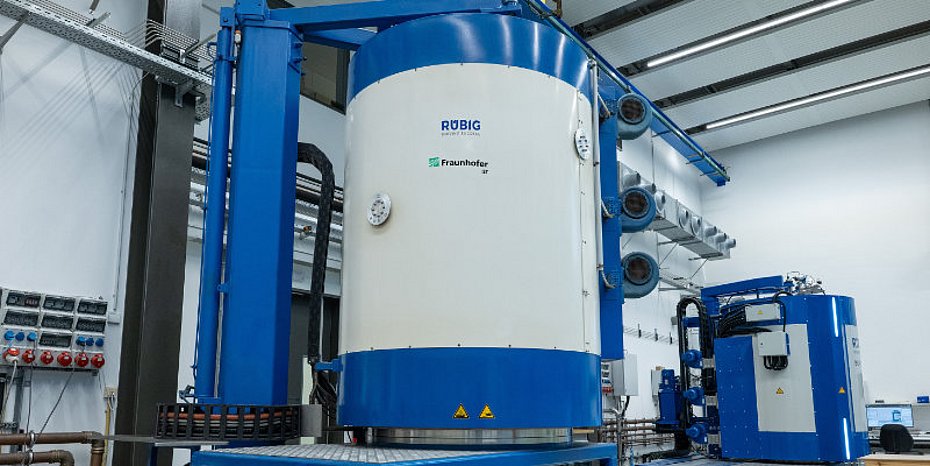
Plasma Nitriding as an Industrial Demonstrator
The methods will first be developed and tested using plasma nitriding as an example. A plasma nitriding system at Fraunhofer IST will serve as an industrial demonstrator; key measurement campaigns with defined reference batches will be conducted on this system, and process, energy, and quality data will be collected and evaluated. The treated components will be characterized with respect to relevant surface layer and service properties so that, on this basis, the sensor technology, data models, and other components of the planned CPPS can be gradually integrated and validated under realistic production conditions.
Approximately 24 MWh in potential savings per year
An initial assessment of the plasma nitriding system’s potential indicates the possible scale of savings: In the long term, approximately 24 MWh of energy per year could potentially be saved. According to the assessment, approximately 17 MWh of this would come from the recovery and use of waste heat, and another 7 MWh from optimized process control. The project will now investigate how these potentials can be technically realized and utilized under realistic production conditions. For manufacturing facilities and contract processors, this could result in lower electricity and operating costs, reduced peak loads, and lower CO₂ emissions. At the same time, more precise monitoring and control of the processes should help reduce the risk of quality deviations and costly rework.
As the project progresses, the plan is to apply the insights gained from plasma nitriding to other thermal and thermochemical processes, particularly PACVD coatings and gas nitriding. In addition, the project will examine the extent to which the developed methodology can be applied to other industrial furnace systems characterized by high temperatures, long process times, and significant waste heat flows. In the long term, the CPPS could also enable cross-plant production planning, in which multiple heat treatment facilities could then be operated in an energy-optimized, load-flexible manner that maximizes grid benefits. (OM-11/26)
About the "CyPro" Project
"CyPro – Cyber-Physical Production Systems for Improving Energy Efficiency and Ensuring Quality in Thermal and Thermochemical Treatment Processes"
Project partners:
- Fraunhofer Institute for Thin Film and Surface Technology IST (Coordination)
- Institute for Machine Tools and Manufacturing Technology (IWF), Technical University of Braunschweig
- Institute for Thermodynamics (IFT), Technical University of Braunschweig
- TLK-Thermo GmbH
- Plasus GmbH
- EKS InTec GmbH
Project-related user group:
- PVA IVS
- Rübig
- Denso
- Oerlikon
Project Duration: June 1, 2026, through May 31, 2029
Funding Information:
This work is funded by the Federal Ministry for Economic Affairs and Energy (BMWE) as part of the 8th Energy Research Program (grant number 3EN4133).
Contact
Fraunhofer Institute for Thin Film and Surface Technology IST
Riedenkamp 2
38108 Braunschweig (Germany)
Phone: +49 531 2155-0
Email: info@ist.fraunhofer.de
www.ist.fraunhofer.de
About the Fraunhofer Institute for Thin Film and Surface Technology IST
As an innovative and internationally recognized partner for research and development, the Fraunhofer Institute for Thin Film and Surface Technology IST develops sustainable products, including the associated competitive and scalable production systems. Its research encompasses plant engineering, complete process chains in process engineering, process technology, and manufacturing technology, all the way to the analysis of entire factories.