
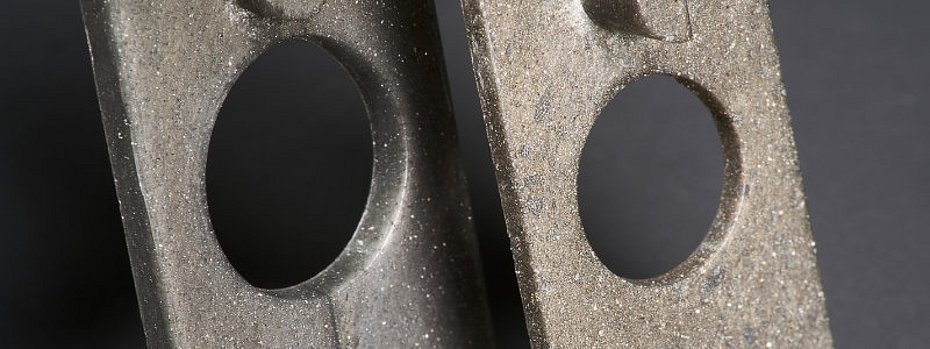
Metallic-looking plastic surfaces are all the rage—whether in automotive exteriors and interiors, toys, or household appliances. However, products manufactured using injection molding have one drawback: they often exhibit so-called flow lines—unsightly streaks and lines. A new method for producing metallic-effect pigments, currently being optimized at the Fraunhofer Institute for Applied Polymer Research (IAP), enables a flow-line-free metallic effect on plastic surfaces—without the need for a coating.
New Pigments for Streak-Free Surfaces
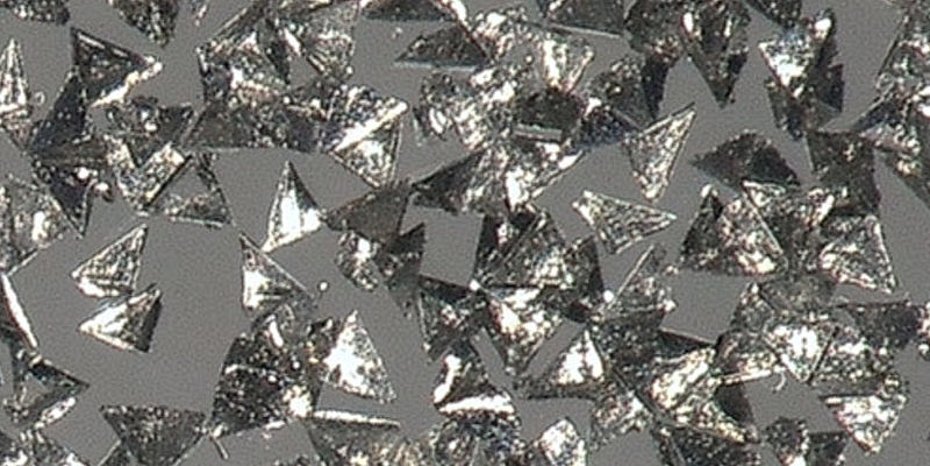
For decades, research has been conducted on optimizing metallic effect pigments, because the conventionally used pigment particles with a platelet or flake geometry—which are incorporated into the plastic to create a metallic effect—produce visible flow lines during injection molding. To address this challenge, the PYCO Polymer Composites Research Division at Fraunhofer IAP is further developing tetrahedral-shaped particles. This geometry makes it possible to precisely control the degree of particle alignment in the plastic melt. Furthermore, it is possible to influence both the formation of flow lines and the brightness flip—that is, the change in brightness depending on the viewing angle. However, the production of these all-aluminum pigments with tetrahedral geometry is complex and associated with a high scrap rate.
Efficient Manufacturing Using UV Imprint Lithography
Together with the team from the Sustainable Lightweight Construction Technologies Group at the PYCO Polymer Composites Research Division, researcher Nils Demski has therefore adopted a new approach: the production of tetrahedral metallic pigment particles using UV imprint lithography. The goal: to minimize pigment waste as much as possible while achieving a high degree of automation through roll-to-roll processes. Instead of aluminum, the pigment particles consist of a UV-cured thermoset that is subsequently metallized; this material meets the thermal and mechanical requirements to retain its shape and optical properties during injection molding. The new process reduces material consumption and significantly lowers the scrap rate compared to conventional production methods. The associated patent is available for acquisition.
“With the new process—on the basis of which we are currently setting up a pilot plant for automated pigment production—we can manufacture metallic-effect pigments with high dimensional accuracy and consistent quality. In addition, the size and, to a limited extent, the geometry of the pigment particles can be adjusted during the process,” explains Demski. Furthermore, the researchers are aiming to develop a monodisperse pigment with a novel tetrahedral particle shape, in which all particles are identical in terms of geometry and size. This enables very precisely adjustable optical effects.
Consistent results with reduced environmental impact
During the injection molding process, the novel pigment particles in the plastic exhibit a uniform, statistically isotropic orientation throughout the entire component. This results in flow-line-free surfaces with a uniform metallic luster that, unlike conventional flake-shaped pigments, orient themselves depending on the flow direction. At the same time, energy and raw materials are saved, as the pigments can be produced in a more resource-efficient manner than conventional aluminum flakes, which are manufactured through metal atomization followed by grinding and screening.
The new manufacturing method for metallic effect pigments combines an attractive appearance with stable and environmentally friendly processes. It is suitable for any application where surface quality, cost-effectiveness, and sustainability are equally important. (OM-7/26)
Contact
Fraunhofer Institute for Applied Polymer Research IAP
Geiselbergstraße 69
14476 Potsdam (Germany)
Phone: +49 331 568-1000
Email: info@iap.fraunhofer.de
www.iap.fraunhofer.de