

The boundary layer behavior of the flow refers to the properties and behavior of the air flow in the immediate vicinity of a solid surface, such as the wing of an aircraft. This layer, known as the boundary layer, is a thin layer in the immediate vicinity of the surface in which the velocity of the flow increases from zero at the surface to the free flow velocity in the surrounding area. Understanding boundary layer behavior is of central importance for the development of efficient, safe and high-performance aircraft. The SE2A Cluster of Excellence for Sustainable Aviation at the Technical University of Braunschweig has succeeded in optimizing and testing the boundary layer with the help of adapted suction panels.
Laminarization of the boundary layer through micro-perforated suction panels
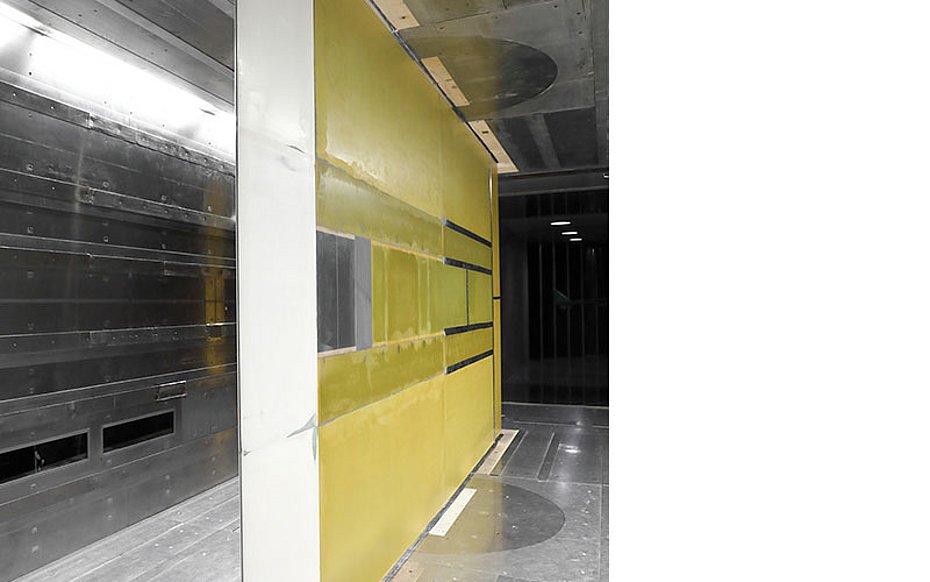
One of the aims of the Cluster of Excellence for Sustainable Aviation is to reduce emissions and energy consumption. The flow behavior of aircraft, especially on the wings, plays a role in this. The researchers use the Braunschweig low-speed wind tunnel (NWB) of the German-Dutch Wind Tunnel Foundation (DNW) for experiments. The wind tunnel enables a very low degree of turbulence, so that a similar boundary layer behavior of the flow can be simulated here as in free-flight experiments. It was also essential to use a highly modular laminar model to demonstrate the efficiency of different suction surfaces with the help of the German Aerospace Center (DLR), which enabled the direct installation of 3D-printed panels.
In an experiment, the TU Braunschweig, in close cooperation with the DLR, was able to prove that it is possible to achieve a so-called laminarization of the boundary layer with micro-perforated - i.e. with tiny holes - suction panels from the 3D printer. This involves a small part of the boundary layer being sucked through the micro-perforated surface, thus stabilizing it. With the new suction panels, the boundary layer of aerodynamic bodies can be changed in such a way that the laminar-turbulent transition is shifted further downstream and the proportion of the laminar boundary layer increases significantly. The advantage of this is that the laminar boundary layer causes up to 90 percent less air friction than the turbulent boundary layer. Air friction accounts for around half of the total drag in modern commercial aircraft. "Laminar flow control is therefore a way of significantly reducing fuel consumption and therefore also the emissions of commercial aircraft," says Hendrik Traub from TU Braunschweig, who is responsible for the production of the 3D-printed surfaces.
Interesting for science and the construction of gliders, light aircraft and commercial airplanes
For the printers, producing the particularly fine micro-perforation with perforation sizes of less than 250 micrometres in diameter was a challenge. Hendrik Traub: "Finding a suitable perforation geometry was therefore a significant part of our research work. The ability to print such surfaces now makes it possible to produce three-dimensionally curved suction surfaces quickly and cost-effectively. This is interesting for science as well as for gliders, light and commercial aircraft."
Why 3D printing?
Until now, suction panels for science have been made from stainless steel or titanium sheets that are micro-perforated either by etching or laser drilling. Both processes provide extraction surfaces suitable for industrial use, which have already been successfully tested in flight trials. To produce curved suction panels that follow a wing contour, for example, the sheets are bent after perforation and glued or welded to a supporting substructure. However, the bending of sheets is limited to 2D curvatures and the subsequent joining of substructures partially closes the perforations again, although this has been proven to have only a minor impact on efficiency. All of these process steps are eliminated with 3D printing. The process allows different geometries, perforation arrangements and substructures to be combined and produced, albeit with slightly increased surface roughness at present.
It took four years of preparatory work to test the suction panels. "First, we examined various 3D printing processes for their suitability for the production of suction panels. We then analyzed printable perforation geometries and substructures. The perforation geometries must allow the printing of very small holes and the substructures must allow a dense but flow-through support of the micro-perforated skin without blocking the holes again." Once the researchers had found an optimal combination, they scaled up the smaller prototypes to entire suction panels for the wind tunnel. Here, too, there was a new challenge: the geometrically complicated but very printable minimal surface substructure reached the performance limits of the CAD and printer software, so they had to switch to a new software architecture with specially programmed libraries. "The challenge lies in the extreme contrast between very precise geometric details, which have to be resolved down to a few micrometers, and the relatively large dimensions of the suction panels themselves."
Production of fully laminar wings planned for 2025
The next major step is to develop and manufacture a second version of the suction panel with a further improved surface for off-design cases without suction. By improving the surface quality, the effectiveness can be increased and a laminar run length similar to that over a smooth, non-perforated surface can be achieved even without suction. This is important in flight phases in which the suction system is switched off or has failed. These tests will again take place in the low-speed wind tunnel in Braunschweig. Based on these models, the first three-dimensionally curved suction panels for a fully laminar wing model developed by the Institute of Fluid Mechanics will then be manufactured in 2025. (OM-3/24)
About the project
While the concept and production were developed at the Institute of Mechanics and Adaptronics (TU Braunschweig), the ongoing aerodynamic pre-tests were carried out in cooperation with the Institute of Fluid Mechanics (Konstantin Thamm, Lajos Fohlmeister, TU Braunschweig). The final wind tunnel test and the model provided were carried out together with the instrumentation by the DLR (Richard von Soldenhoff, Heinrich Lüdeke, Institute of Aerodynamics and Flow Technology).
Contact
Technische Universität Braunschweig
Cluster of Excellence SE²A - Sustainable and Energy-Efficient Aviation
Hermann-Blenk-Str. 42
38108 Braunschweig (Germany)
E-mail: se2a@tu-braunschweig.de
Phone: +49 531 391 66661
www.tu-braunschweig.de/se2a
About the SE²A Cluster of Excellence
The SE²A Cluster of Excellence is an interdisciplinary research project with the aim of researching technologies for the sustainable and environmentally friendly development of air transport. In the cluster, scientists from the fields of aviation, electrical engineering, energy, chemistry and design are working on lowering emissions, reducing noise pollution, the recyclability of air transportation systems and the further development of air traffic management.In addition to the TU Braunschweig, the German Aerospace Center (DLR), Leibniz Universität Hannover (LUH), Braunschweig University of Art (HBK) and the Physikalisch-Technische Bundesanstalt (PTB) are involved in SE²A on the basis of cooperation agreements.