
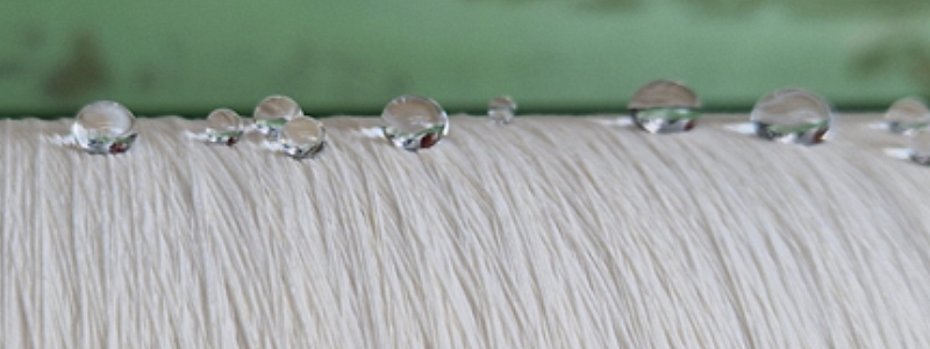
Hiking, jogging, cycling - you can easily be caught out by wind and weather during outdoor activities. Modern functional clothing can be waterproof and dirt-repellent, but is often impregnated with PFAS-containing chemicals. It is not easy to replace these harmful substances. Researchers at Empa are therefore working with textile manufacturers to develop a technology that can be used to find substitutes for PFAS and use them more precisely - in line with the safe-and-sustainable-by-design principle.
Chemical impregnation is necessary for functional clothing to withstand all weathers. However, rain jackets, swimming trunks and the like with a PFAS-containing coating contribute to environmental pollution with fluorine-containing eternity chemicals. Replacing this group of substances is no trivial matter, as they have excellent properties: PFAS are water-, dirt- and grease-repellent. Empa researchers are therefore working together with partners from industry to develop technologies and materials with which PFAS-free textiles with the desired properties can be produced sustainably and economically. The innovative project originated from the Subitex network, a long-standing collaboration between companies from the Swiss Textile Association Swiss Textiles and Empa in St. Gallen. The "EC0Tex" project, which is funded by Innosuisse, aims to produce water-repellent coatings for textile yarns by using fluorine-free substances in a specially developed plasma coating system. The project was recently presented with the "Innovation Award" for sustainability and innovation at the international trade fair "Techtextil" in Frankfurt am Main.
PFAS replacement without remorse
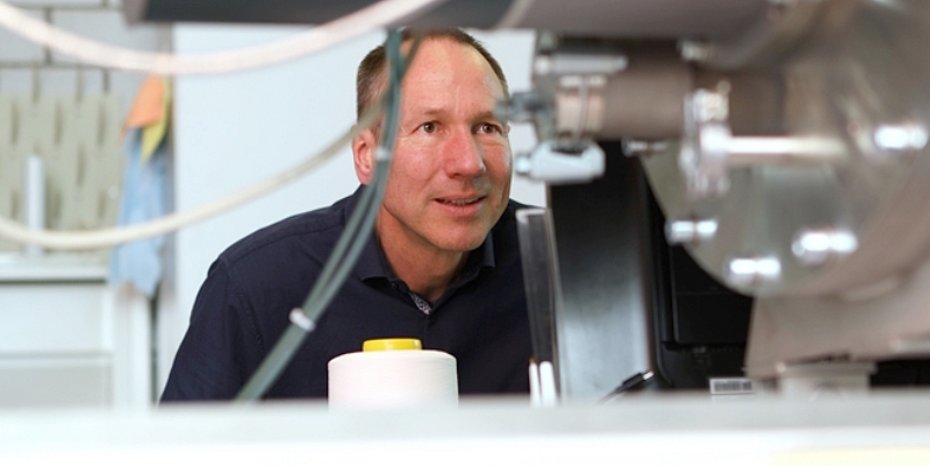
The "Safe and Sustainable by Design" principle, or SSbD for short, is central to the "EC0Tex" project. "In the search for alternatives to PFAS, the aim is to avoid producing so-called regrettable substitutes, i.e. substitutes that subsequently turn out to be just as harmful as the chemical originally used," says Empa researcher Dirk Hegemann from the Advanced Fibers Laboratory in St. Gallen. This is why the team led by Dirk Hegemann, Martin Amberg and Patrick Rupper uses risk analyses to compare the needs of industry, the environment and society early on in the development process and filters out those materials and technologies that fail in terms of the desired properties, sustainability or cost-effectiveness.
Industrial impregnation process using plasma technology
Together with implementation partners from the Swiss textile industry Bäumlin & Ernst AG, Lothos KLG and Seilfabrik Ullmann AG, a new type of impregnation process suitable for industrial use is being developed using plasma technology. This is because PFAS-free substances would have to be used in excessive quantities with conventional techniques in order to produce the material properties of PFAS-coated textiles. The result: points deducted for cost-effectiveness and sustainability, which makes the search for viable alternatives according to SSbD standards a challenge.
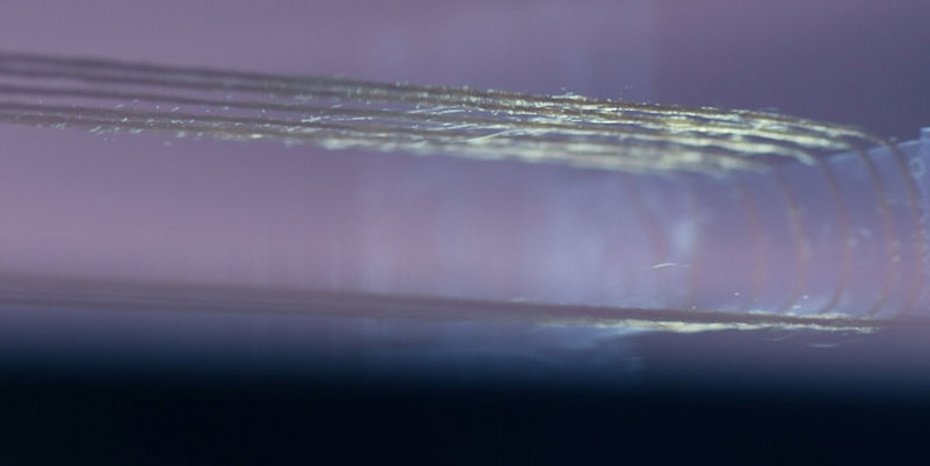
However, the new plasma system, which was designed for this purpose together with Empa researchers, makes it possible to apply extremely thin coatings to the individual fibers in a yarn. "This allows us to significantly reduce the amount of chemicals used and at the same time achieve comprehensive impregnation of the yarns," says Hegemann. The yarns produced in this way could be used directly for the production of outdoor and sportswear, as well as ropes, according to the researcher. In plasma-induced coating technology, plasma is generated in a chamber by means of an electrical gas discharge. As high energy is provided at a low temperature, the chemicals in the chamber evaporate and form reactive species that dock onto the individual fibers of a yarn. Usually, however, only the outermost fibers of a textile can be impregnated in this way. "We have taken a new approach: The new plasma coating system produces differently reactive species that can also penetrate deep into the yarn structure," explains Empa researcher Dirk Hegemann. This results in a durable and penetrating coating.
The challenge of plasma technology: grease and dirt
As an alternative to PFAS, the researchers are now investigating how organosilicon compounds can be used for impregnation. Their harmlessness, even when exposed to the environment, for example through abrasion or washing, must be analyzed in detail. Initial analyses show that the organosilicon compounds form highly cross-linked layers with outstanding properties in terms of water repellency and fast drying, which even surpass those of PFAS impregnations in terms of resistance.
One challenge at present is the grease and dirt repellency that PFAS textiles can provide. According to Hegemann, further work is needed to replace PFAS in textiles such as protective workwear. The large group of organosilicon compounds opens up a wide range of possibilities here. Thanks to plasma technology, it is now also possible to find further new solutions by adapting the starting substances and coating conditions and tailoring them to the desired properties of the textiles - while at the same time keeping the "Safe and Sustainable by Design" principles in mind.
Exposure for generations: PFAS in the environment
PFAS chemicals end up in the environment and pollute it for generations. The substances in this huge class of substances accumulate in the environment, some even in the human body. PFAS are associated with various diseases such as cancer, metabolic disorders and immune damage. There are also known effects on fertility and on babies in the womb. The use of safe alternatives is therefore urgently needed (OM-5/26).
Contact
Empa
Coating Technologies
Überlandstrasse 129
8600 Dübendorf (Switzerland)
Phone +41 58 765 11 11
www.empa.ch/web/s208/coating-technologies
About Empa
The Swiss Federal Laboratories for Materials Science and Technology (Empa) is the ETH Domain's interdisciplinary research institute for materials science and technology. As a bridge between research and practical application, it develops solutions for the primary challenges facing industry and creates the scientific basis for the sustainable development of our society.