
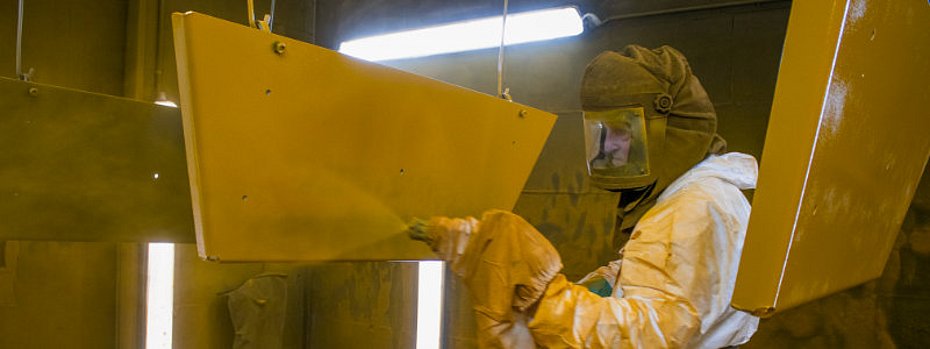
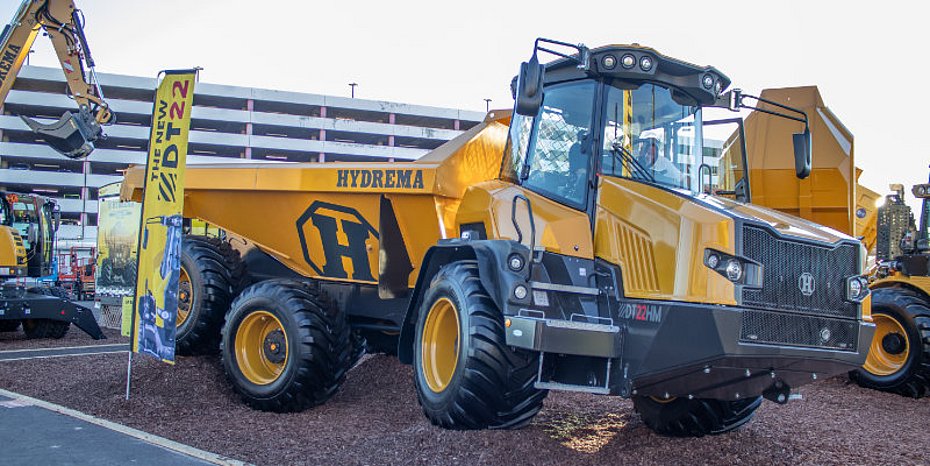
Hydrema is one of the leading premium manufacturers of construction and earthmoving equipment. As a Danish, family-owned company, Hydrema combines technical expertise with a clear brand identity. Its headquarters are located in Støvring, Denmark; with another key production site in Weimar, Germany. Manufacturing takes place exclusively at these two locations, while the machines are shipped worldwide. The product portfolio includes dump trucks, backhoe loaders, and mobile excavators, which are in use in Europe, Australia, New Zealand, and the U.S., among other places.
Within the Hydrema Group, Marianne Frank Mogensen, the company’s Purchasing Manager, serves as the central point of contact for all questions related to coatings. For more than 30 years, she has been coordinating strategies and specifications in this role and focusing on future internal requirements in industrial painting. Selecting the right paint system is therefore far more than a purely technical decision for Hydrema. At both production sites, painting plays a key role in the manufacturing process. “The right paint has a significant impact on how durable a machine remains in daily use, how it is perceived in the market, and what value it retains over the long term. At the same time, the painting process must be reliably integrated into the production process, as it plays a major role in determining lead times and production cadence. For us, therefore, it is not a secondary consideration, but an integral part of our quality commitment,” explains Marianne Frank Mogensen.
Growth as a Challenge for the Paint Shop
Thanks in no small part to the high quality of its machines and steadily rising demand, Hydrema has grown continuously in recent years. As a result, production requirements have also increased—particularly at the Weimar facility. There, production capacity was significantly expanded, while the regulatory VOC emission limits remained unchanged. For the painting department, this created considerable pressure to act: Higher production volumes had to be achieved within the existing emissions regulations. Against this backdrop, the focus shifted to changing the paint system. The new solution was intended to further improve surface finish and quality even as production increased, while ensuring process reliability. At the same time, it was meant to alleviate the VOC situation at the site. “The single-coat approach was therefore the logical step,” said Marianne Frank Mogensen.
Single-Coat Paint Ensures Process Flow
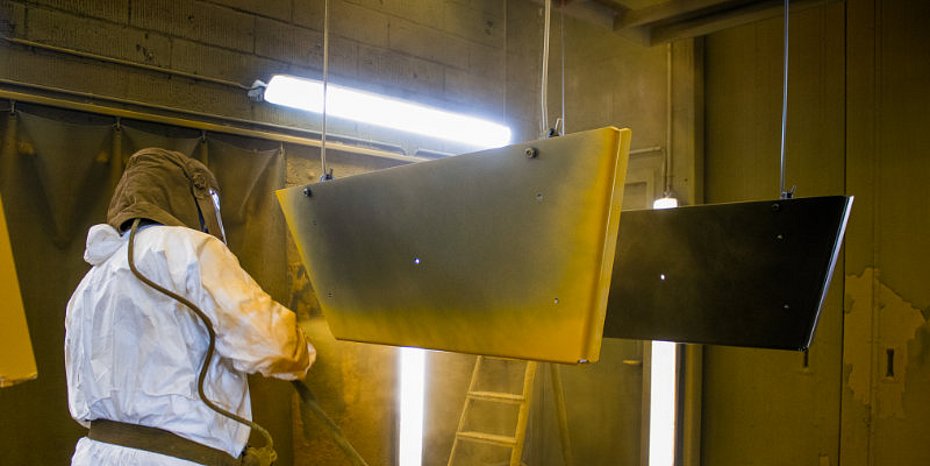
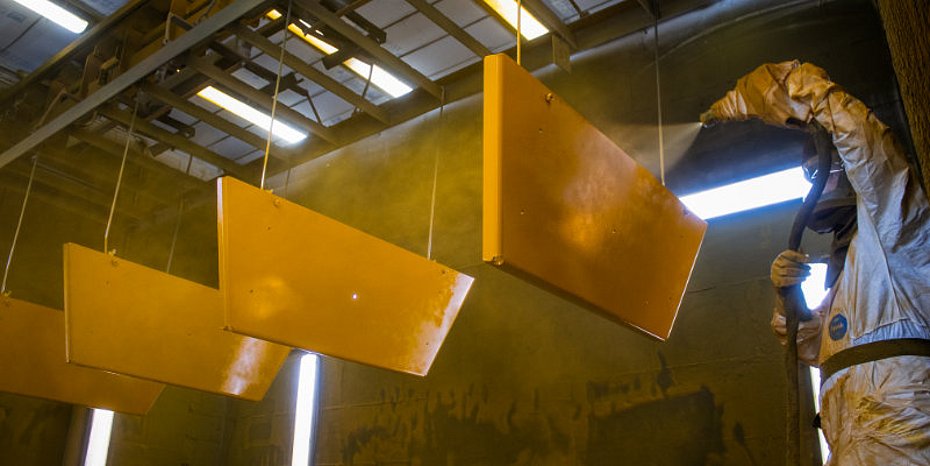
The decision was ultimately made to use a single-coat solution with Alexit High Build Monolayer from Mankiewicz Coatings. Hydrema was already familiar with the paint manufacturer from other applications, and the company also had experience with the product and its application. The key now was to jointly develop a solution and reliably implement it in production—one that would consistently meet Hydrema’s requirements for surface quality, process reliability, and turnaround time. “We very quickly developed a shared understanding with Mankiewicz regarding our production—not just the painting process itself, but the entire process behind it. The switch to the single-coat system was first implemented in Weimar, where the need for action was greatest. Within a short time, the product was reliably established in production,” explains Marianne Frank Mogensen.
The switch to the high-build monolayer system quickly brought Hydrema measurable benefits: By switching from a two-coat system to a single-coat system, VOC emissions were reduced by 30 to 40 percent. At the same time, the new coating system improved corrosion protection and led to significant process optimizations. The change also had a noticeable impact on the production flow: Since the components now go through only one process step, Hydrema in Weimar is able to achieve a higher throughput in the same space—without any additional paint booths. “The changeover has made us significantly faster and more efficient. The key factor here is that the drying times align precisely with our conveyor system. The parts must be sufficiently cured and ready for handling within a fixed time window,” says Marianne Frank Mogensen. Just 2.5 hours after painting, the components are ready for assembly. Mankiewicz helped Hydrema reliably meet these process times.
According to the purchasing manager, the High Build Monolyer also offers more flexibility when it comes to color matching. In addition to the standard colors—Hydrema yellow, black, and gray—customer-specific colors can also be reliably produced. To do this, Hydrema submits the desired color shades to Mankiewicz with sufficient lead time. The paint manufacturer develops the color shade using its in-house colorimetry system and produces the paint in the desired variant. The quality remains unchanged throughout the process. “For the painters, this is a decisive advantage: mixing ratios, viscosity, nozzles, pressure, and temperature remain the same. They don’t have to adjust to a new system, but instead always work with familiar parameters,” says Marianne Frank Mogensen. This consistency in the process increases efficiency while also providing the necessary flexibility for customers who want machines in their corporate design.
Color stability during parallel operation
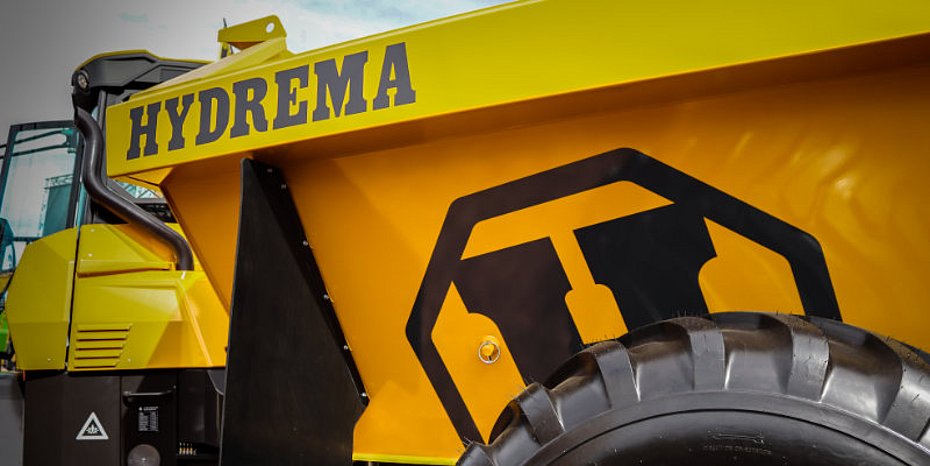
In addition to the process advantages, the transition was not to disrupt the production network with Støvring. While Weimar was already using the High Build Monolyer, Støvring initially continued to use the previous coating system. It was therefore crucial that the Hydrema yellow appear identical across both sites—both visually and in terms of measurement. “It was clear to us: Even if both plants were temporarily working with different systems, every component had to fit together in the end. With around 50,000 part numbers, even a slight deviation in the surface appearance would have been a major problem. The machine must look as if it were cast from a single mold,” says Marianne Frank Mogensen, describing the challenge.
Especially for the defined Hydrema yellow, the color was matched based on a sample sheet provided by Hydrema. The tighter Delta-E tolerances at Mankiewicz played a key role in this process. Compared to the previous tolerance window of 1.0, this allowed the color shade to be adjusted with significantly greater precision and reproduced consistently. It was also crucial for Hydrema that the shade of yellow appear consistent even under varying lighting conditions. Mankiewicz therefore conducted comprehensive testing of the color at its in-house testing center and documented the results in detailed test reports. “In the end, no difference in the shade of yellow was detectable—neither in a direct comparison nor under critical lighting conditions. That gave us the confidence to operate the systems in parallel,” said Marianne Frank Mogensen.
Proven in the Field: Corrosion Protection and Long-Term Appearance
For Hydrema, the switch to the High Build Monolyer was crucial not only for process and environmental reasons, but also with regard to the long-term quality of the machines. Compared to the previous coating system, the company achieved a higher corrosion protection class with C3 VH (ISO 12944)—an important factor, as Hydrema machines are constantly exposed to rock chips, dirt, lubricants, and other stresses when in use on construction sites.
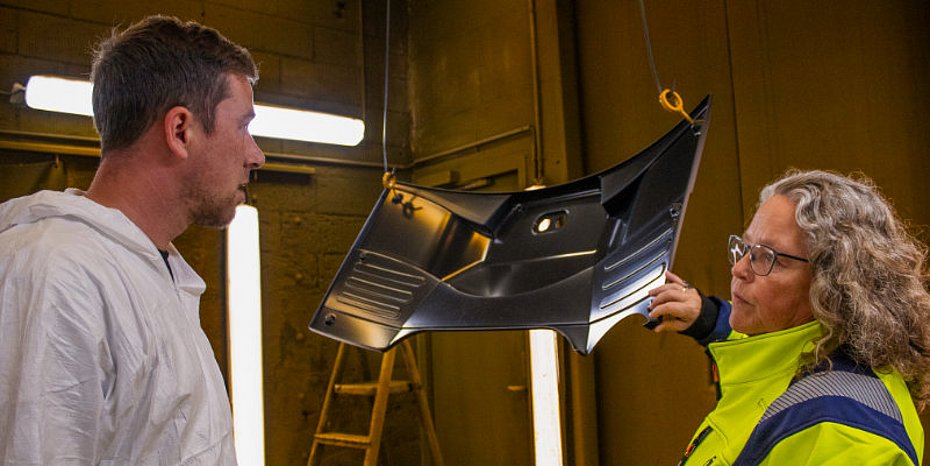
At the same time, it became clear that the improved environmental performance does not come at the expense of surface quality. “Our machines leave the factory in top condition. And even though they lead a tough life in the field, they should maintain their visual appeal for years to come,” emphasizes Marianne Frank Mogensen. The fact that Mankiewicz thoroughly tests and documents the systems in advance provides Hydrema with additional assurance: Unlike in the past, no in-house field tests are necessary after one or more years of use to verify surface appearance, color stability, or UV resistance. This process stability is crucial for Hydrema and will therefore also apply to supplier parts in the future. Since the machines are designed for a long service life, low maintenance costs, and high operational performance, consistent coating quality across all components is particularly important.
Switch to single-coat paint in Sweden as well
Since the beginning of the year, the Støvring site has also been fully converted to a single-shift operation. Looking back, Marianne Frank Mogensen describes this step as relatively straightforward, since Hydrema was able to draw on the experience gained in Weimar and successfully replicate the process. “In Weimar, we worked with Mankiewicz to consider every possible scenario. That’s why we knew the system would work in Støvring as well—and that’s exactly how it turned out,” she says. Even though there are no comparable VOC regulations in Denmark, Hydrema, as a manufacturing company, saw a clear responsibility to further reduce emissions at this site as well and to meet its own ESG requirements.
Marianne Frank Mogensen sums it up clearly: “Basically, the project can be summed up in one word: successful—in every respect. We’ve gained capacity, ensured quality, and, above all, won over the people who work with the product every day. Even experienced painters who have been with the company for decades support the change. One employee hugged me and said, ‘Marianne, it’s so good and so easy.’ That says it all. When the employees are behind it, we’ve all won. (OM-8/26)
Contact
Mankiewicz Gebr. & Co. (GmbH & Co. KG)
Georg-Wilhelm-Straße 189
21107 Hamburg (Germany)
Phone: +49 40 751030
Email: info@mankiewicz.com
www.mankiewicz.com
About Mankiewicz
Since 1895, the long-established company Mankiewicz has been manufacturing and distributing high-quality industrial coatings. Today, a team of over 1,500 employees works at 16 locations worldwide. In its state-of-the-art laboratories, technical centers, and production lines, this globally active coatings company develops high-tech coating systems around the world.