
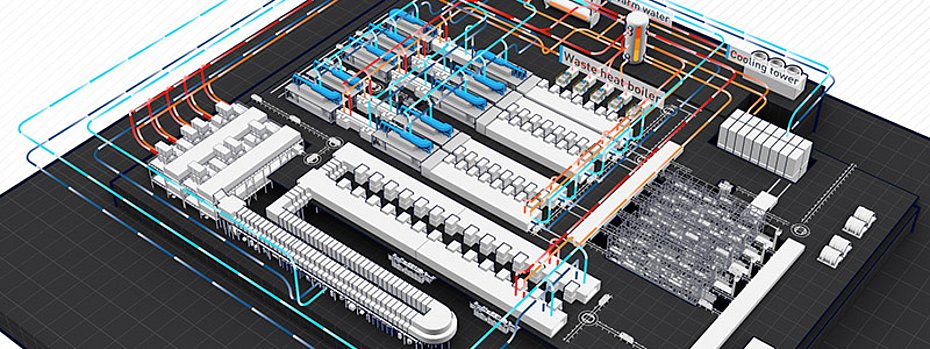
High energy prices, uncertainties in gas supply and climate targets requiring CO2-neutral production pose major challenges for paint shop operators. To overcome these, Dürr offers EcoQPower, a new solution to ensure that paint shops run optimally in terms of energy, regardless of production conditions. EcoQPower is based on a comprehensive analysis of the individual heating and cooling requirements of a paint shop and networks all components so intelligently with each other that their efficiency increases massively and virtually no energy remains unused. "EcoQPower is a milestone in energy efficiency. We achieve energy savings in the double-digit percentage range even at locations that are climatically ideal for operating a paint shop. This is equivalent to the amount of energy needed to paint 13,000 to 20,000 cars," says Dietmar Wieland, Senior Manager R&D, at Dürr.
The energy supply of the entire paint shop in view
On the way to a sustainable paint shop, many individual adjustments have been made, from products and layouts to digitization, in order to make paint booths, dryers, and ventilation concepts more and more energy efficient. Instead of continuing to optimize individual elements, EcoQPower focuses on the paint shop as a whole, including the energy input by the plant operator. In order to make maximum use of all available energy sources, all energy flows for supplying all process steps of the paint shop are networked with each other.
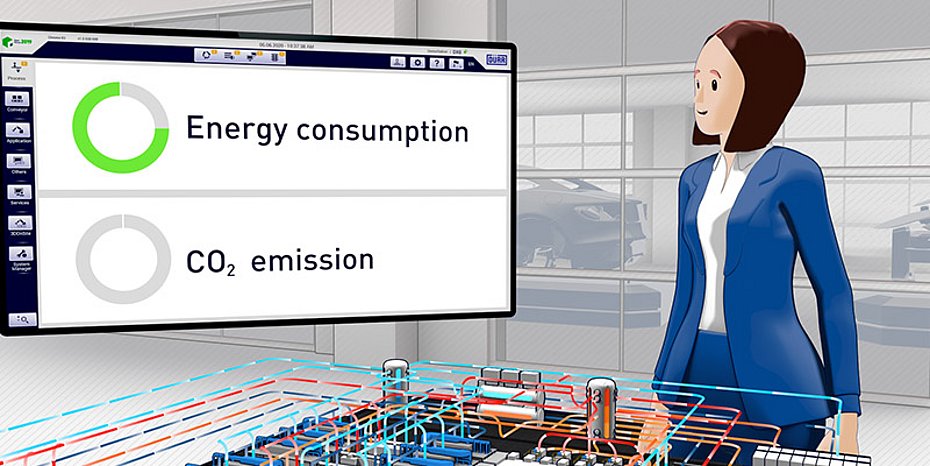
Intelligent network for energy flows
The right networking, which requires a high level of know-how, is the decisive factor. It is comparable to the human nervous system, via which the body receives information and controls a wide range of mechanisms. In a figurative sense, the interconnections in the paint shop form the "nervous system" via which the heat and cold flows can be passed on from one process area to another. The effect: Instead of supplying each process area - for example, the paint booth, dryer or pretreatment - with energy in isolation and often wasting energy in the process, each process area only receives exactly the amount it really needs.
Identify and use sources of waste heat
In the electrification of processes, it is relevant for the integration of heat pumps at which temperature level heat has to be provided. Until now, there was one level for all processes, which was based on the temperature of the intermediate dryers of 80°C, for example. However, the high-temperature water is also used to operate ventilation systems, which only heat the room air to around 21°C. This is where EcoQPower comes in. This is exactly where EcoQPower comes in. Each process not only receives the appropriate amount of energy, but also the required temperature level. This means that previously unused sources of waste heat can be tapped. To make this possible, Dürr has developed software that determines the demand for heating and cooling in the form of a source-sink profile. This also takes into account the climatic site conditions, as well as general framework data such as production capacities, vehicle types and existing energies such as geothermal or solar thermal energy, which can be integrated. Since each process has different requirements, e.g. for the temperature level of heating and cooling, Dürr clusters the different levels in order to combine them in a way that makes economic sense. Knowing which waste heat sources can be used for what makes it possible to draw synergies from the processes and to select and precisely design the hardware components, such as heat pumps, hot and cold water tanks or a cooling tower, to suit their purposes.
Keeping ongoing operating costs under control
EcoQPower is also taking a new direction in the provision of energy, which has so far been centralized for automotive plants. For energetically optimal solutions, the cold and heat is generated electrically decentrally within the paint shop, recovered there and distributed again to the components via intelligent networking. "EcoQPower improves the energy efficiency of any new plant, most of all, of course, in combination with particularly energy-saving products, such as our electrically operated EcoInCure dryer and the Oxi.X RV electric exhaust air purification system. We are using these in our first project with EcoQPower in a new, fully electrified paint shop for a German car manufacturer, thus minimizing energy consumption to such an extent that the additional costs of switching to electricity as a more expensive energy source are largely offset," explains Dietmar Wieland. The high energy efficiency of a paint shop electrified according to the EcoQPower concept thus helps not only to become independent of gas and to keep ongoing operating costs under control, but also to operate a complete paint shop in a CO2-neutral manner by using green electricity. (OM-07/23)
Contact
Dürr AG
Carl-Benz-Str. 34
74321 Bietigheim-Bissingen (Germany)
Phone: +49 71 42 78 0
E-Mail: corpcom@durr.com
www.durr.com