
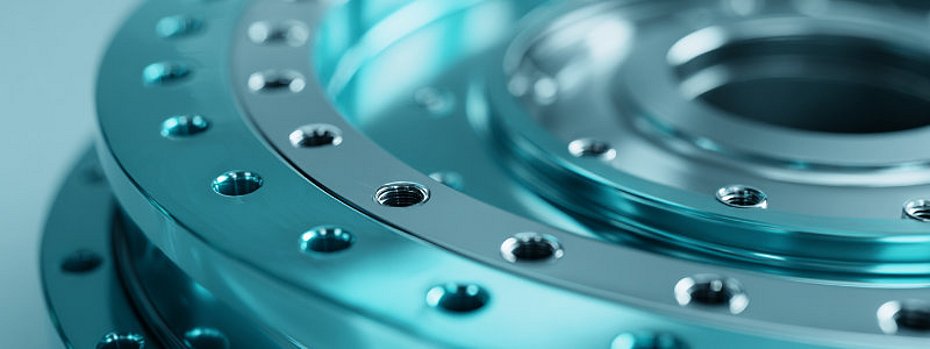
Anyone who has components coated will sooner or later ask themselves the same question: liquid paint or powder coating? Both processes are well-established in industrial surface finishing—but they differ fundamentally in terms of their respective strengths. There is no one-size-fits-all answer. The decisive factor is what the component and the application actually require.
Powder and liquid coatings: Two processes, different strengths
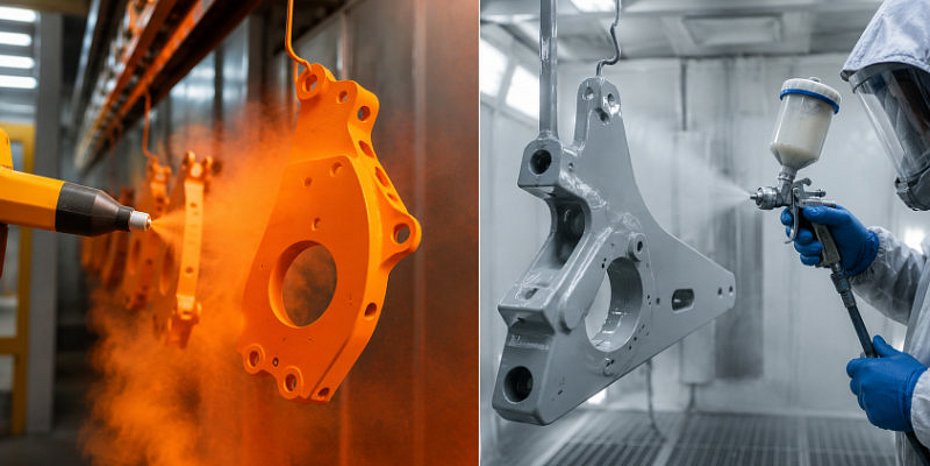
In powder coating, a dry powder is applied to the workpiece using an electrostatic charge and then baked into place. The process is efficient and well-established, particularly for uniform metal components with simple geometries. Wet painting relies on liquid coating systems that can be specifically tailored to the material, geometry, and requirements. This opens up technical and design flexibility, which often makes the difference in practice.
Powder coatings are limited to specific materials and process temperatures. Liquid paint is significantly more versatile—suitable for various materials, sensitive components, and custom requirements. Those who not only coat standard parts but also require tailor-made solutions benefit significantly from this.
Wet paint for greater creative freedom
Complex geometries with edges, cavities, or delicate structures place high demands on any coating. Liquid paint allows for precise application control and is particularly effective in applications where surface appearance is just as important as protection.
When color and finish are meant to be more than just functional, liquid paint generally offers greater creative freedom. Custom colors, specific gloss levels, and special surface requirements can often be achieved with greater precision than with powder—an advantage wherever the coating also contributes to the perceived quality of the final product.
High curing temperatures for powder coatings
Powder coating requires high curing temperatures. This can be a limitation when dealing with sensitive materials or combinations of components. Liquid paint offers greater flexibility in terms of process technology and can be applied in a way that is gentler on the material—a factor that is relevant wherever temperature is a critical variable.
Another practical consideration: Surfaces occasionally need to be touched up. With liquid paint, spot repairs are generally easier to perform than with powder coating—offering a cost advantage when components cannot be easily replaced.
Which coating process is the right one?
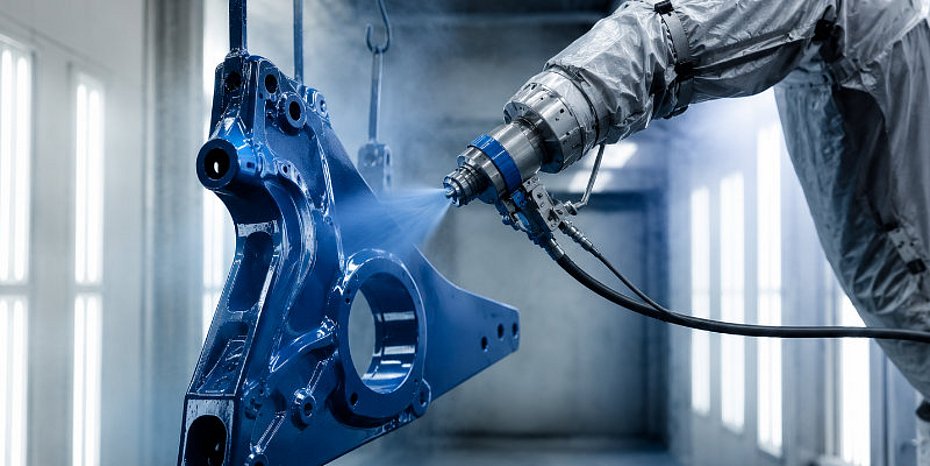
Powder coating remains a solid choice for simple geometries, standard metal components, and high-volume production. But as soon as requirements increase—both technically and visually—it’s worth considering liquid painting. The best coating isn’t the cheapest or fastest, but the one that truly suits the component, its intended use, and the quality standards.
Stoz GmbH provides practical and honest advice to customers, tailored to the material, geometry, application, and desired surface finish. The right solution for your requirements will be found by working together. (OM-7/26)
Quick Facts About Powder and Liquid Coating
Powder coating is efficient and durable, but is particularly well-suited for simple geometries and high-volume production of metal components.
Wet painting offers greater flexibility in terms of material, shape, and design—ideal for complex components and custom requirements.
For delicate structures and hard-to-reach areas, wet painting often allows for a more uniform and precise coating.
Temperature-sensitive components benefit from liquid painting, as it does not require high curing temperatures like powder coating does.
Contact
Stoz GmbH
Industriestraße 6
72108 Rottenburg-Hailfingen (Germany)
Phone: +49 7457 94450
Email: info@stoz.de
www.stoz.de
About Stoz
Stoz GmbH is a partner for all services related to the demanding world of industrial coating. With over 95 years of experience in the coating industry, the company combines tradition with innovative strength—offering state-of-the-art, customized solutions ranging from individual pretreatment and cutting-edge application techniques to precisely tailored coatings that meet customer requirements and industry specifications.