
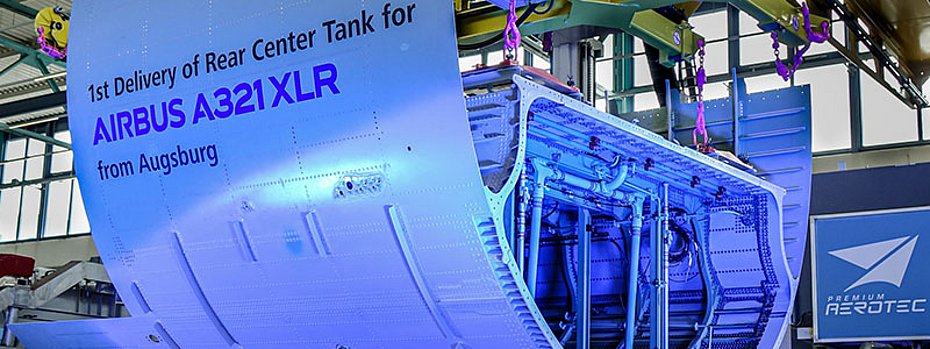
The turnkey paint shop currently being built by Dürr for the Airbus Premium Aerotec division is the largest single project that the mechanical and plant engineering company has ever implemented for the Airbus Group. The plant will be used to coat the auxiliary fuel tank that enables the new Airbus A321XLR's long range. For the first time, an all-electric exhaust air purification system will also be integrated into a Premium Aerotec paint shop at the Augsburg site, helping to reduce CO2 emissions.
The fuel tank integrated into the fuselage of the Airbus A321XLR is the key component that turns the new XLR (eXtra Long Range) version of the previous short and medium-haul aircraft into a long-haul aircraft. The so-called Rear Center Tank (RCT) with a capacity of 13,000 liters increases the range of the aircraft by up to 8,700 kilometers. The Rear Center Tank is produced exclusively at the Augsburg site.
High demands on surface protection and tightness
The turnkey project covers the entire process, from preparation and sealing to the actual painting. The new painting system consists of sealing, cleaning and painting booths. There is also a surface and leak test. The requirements in terms of corrosion and diffusion are high. The surface of the tank must be able to withstand the extreme conditions on the underside of aircraft without corroding.
Special air routing reduces energy consumption
Paint booths require constant temperatures and humidity to ensure the very high level of surface protection required. Conditioning requires a lot of energy, especially for manually applied paints, where the use of recirculated air is not permitted and the booth is operated with supply and exhaust air. "In order to make the process more energy-efficient for Airbus, we are implementing a component-specific air routing system that significantly reduces the amount of air required, but still complies with safety requirements and standards. Because the less air that needs to be conditioned, the lower the energy consumption," explains Marc Furmannek, Key Account Manager at Dürr. In addition, energy recovery systems are used that reuse 65 percent of the energy contained in the exhaust air to condition the fresh air. This further minimizes energy consumption.
Pollutant removal without additional CO2
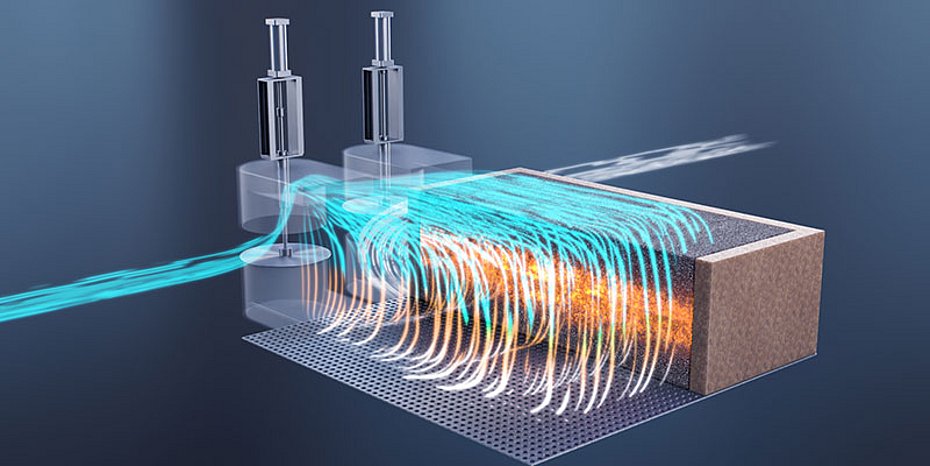
For reasons of sustainability, Premium Aerotec opted for an all-electric exhaust air purification system - the Oxi.X RV. This is based on the regenerative thermal oxidation (RTO) process and is based on a flameless mode of operation with a unique design. The advantage is that the combustion process for cleaning the exhaust air takes place entirely within the heat exchanger material. There is therefore no open flame, which results in particularly low nitrogen oxide emissions. As the entire process is electrified, it can be operated completely emission-free with green electricity, i.e. without additional CO2.
Increase profitability
The exhaust air streams produced contain very low solvent concentrations. However, as the exhaust air volume is large, a Sorpt.X CD is installed upstream of the Oxi.X RV, which concentrates the exhaust air flows. This means that the volume is reduced, which increases the solvent concentration - up to forty times the original pollutant concentration. This technical effect means that the downstream Oxi.X RV can be smaller and does not require any additional heating energy during solvent operation, which has a positive effect on the cost-benefit ratio of exhaust air purification. (OM-9/24)
About Dürr
The Dürr Group is one of the world's leading mechanical and plant engineering companies with strong expertise in the areas of automation and digitalization/Industry 4.0. Its products, systems and services enable highly efficient and resource-saving manufacturing processes in various industries.