
From its very beginnings 35 years ago, the German Federal Environmental Foundation (DBU) has been closely linked to project funding in the eastern German states—then known as the “new” federal states—working to advance climate and environmental protection in the fight against human-induced climate change. In a funded project in Saxony-Anhalt, small and medium-sized enterprises are developing groundbreaking solutions for the massive powder coatings market to replace fossil-based raw materials with bio-based ones. The project is receiving approximately 370,000 euros in support from the DBU. “This and other DBU-funded projects in Saxony-Anhalt are true masterpieces of the SME sector. They exemplify how business and environmental protection can advance each other,” said DBU Secretary General Alexander Bonde.
Sustainable Powder Coatings for Industrial Applications
The “EcoCoat – Sustainable Powder Coatings for Industrial Applications” project could become “a gateway to previously unknown production processes” for the entire industry and especially for smaller and medium-sized companies. Bonde: “For the first time, the project has succeeded in developing bio-based powder coating formulations.” In this context, the DBU Secretary General recalled the development of the DBU’s funding activities in the eastern German states. While the focus in the early years following the founding of the German Federal Environmental Foundation was primarily on emergency aid and the remediation of environmental damage, a different guiding principle now prevails. Bonde: “Today, in light of climate and environmental protection goals, the priority is to use energy and raw materials more efficiently. Small and medium-sized businesses in Saxony-Anhalt are leading the way in showing how economics and ecology can work hand in hand to curb human-induced climate change.”
Coating powders for doors, windows, and facades—and electric guitars
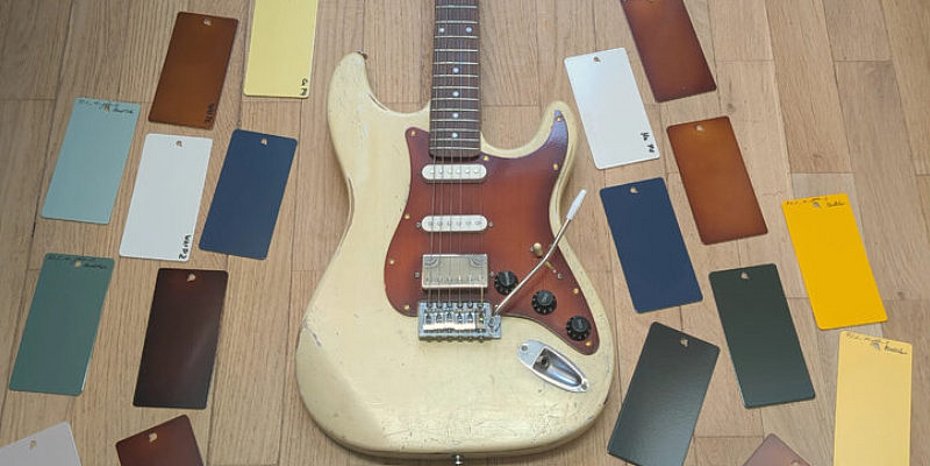
The powder coating project fits right in here. This refers to coating powders used to protect and finish metallic surfaces in numerous industrial sectors, including door, machinery, window, and facade construction; the automotive and furniture industries; architecture; and household appliances, such as washing machines. And in addition to fences and railings, even electric guitars. The market is huge. While powder coatings can be manufactured and applied without solvents, there is still one catch: Their recipes—known in technical jargon as “formulations”—are based almost exclusively on fossil petroleum. This is particularly true of the binders, which—along with fillers, pigments, and additives—are among the essential components of a powder coating. The production volume of powder coatings in Europe alone is around 450,000 metric tons per year. According to the Association of the German Coatings and Printing Inks Industry (VdL), powder coatings account for approximately 12 percent of the total revenue of the industrial coatings sector. According to industry data, the global market size for powder coatings in 2025 was the equivalent of 14 billion euros. Estimates suggest that this market will grow to the equivalent of approximately 23.7 billion euros by 2034, with the Asia-Pacific region serving as a key growth driver. Bonde commented: “There is therefore enormous potential for innovative solutions to reduce greenhouse gas emissions, energy costs, and raw material consumption.”
Manufacturing powder coatings with minimal use of fossil-based raw materials
“This is exactly the kind of proof that was achieved in this ‘great project,’” says engineer Dr. Susanne Bender. She is the managing director of iLF Magdeburg GmbH, which is part of the consortium responsible for the project. iLF is regarded as an internationally recognized testing service provider with its own research activities in surface engineering. Also involved were Ganzlin Beschichtungspulver GmbH—a company with about 70 employees that manufactures powder coatings—as well as the Core Facility Microscopy and Materials Analysis (CMMA) at Otto von Guericke University Magdeburg. iLF Managing Director Bender: “The project results demonstrate the fundamental technical feasibility of producing powder coatings largely without fossil-based raw materials.” She noted that “the combination of more sustainable raw materials and a lower curing temperature” is particularly interesting. According to her, the research project succeeded in “reducing this curing temperature from about 200 to 160 degrees Celsius”—with impressive results: energy consumption and associated costs were reduced by about one-third. Added to this is the environmental benefit: According to Bender, the use of bio-based binders such as bio-resin and recycled PET has significantly reduced emissions of climate-damaging greenhouse gases like carbon dioxide (CO2). The use of carbon black, chlorophyllin, lignin, and indigo as pigments also contributes to this. Bender: “The carbon footprint has been reduced by more than 70 percent.” (OM-9/26)
Contact
German Federal Environmental Foundation
An der Bornau 2
49090 Osnabrück (Germany)
Phone: +49 541 9633 0
Email: info@dbu.de
www.dbu.de
About the German Federal Environmental Foundation (DBU)
The German Federal Environmental Foundation (DBU) is one of the largest foundations in Europe. It supports innovative, exemplary projects in the field of environmental protection. Since the foundation began its work in 1991 (it was founded in 1990), it has supported more than 11,500 projects with approximately 2.18 billion euros in funding. The foundation’s endowment stands at three billion euros.