
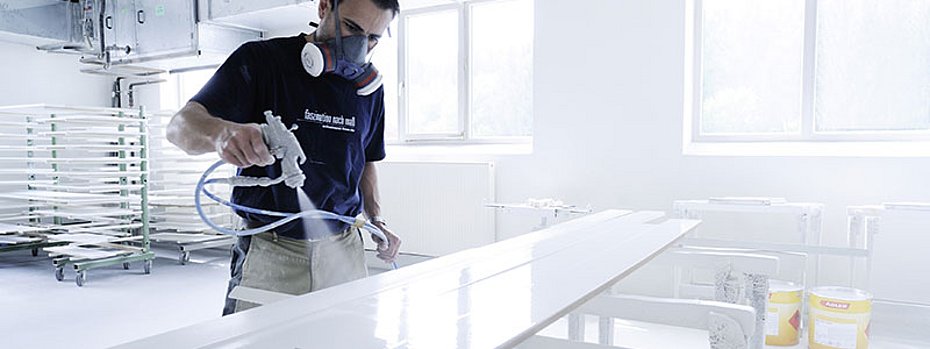
Many companies are considering switching to water-based paints - for good reasons: Water-based paint systems are environmentally and climate-friendly, offer clear health and safety benefits and are also attractive from an economic point of view. But how much organizational effort is involved in the changeover? What investments are necessary? And do water-based paints really offer the same quality? Manuel Mathes, application and training expert at Austrian paint manufacturer Adler, has already helped many processors switch to water-based paints and therefore knows exactly what is important. In this interview, he answers the most important questions.
Manuel Mathes: "It's actually quite simple: water-based paints have no relevant disadvantages, but they do have many advantages. They are good for the environment and climate protection, they are good for health and safety during processing, they are easy to store and dispose of, and they are at least on a par with solvent-based products in terms of quality. And another very important point: in most cases, they are also noticeably cheaper!"

Manuel Mathes: "Although the price per kilo is usually slightly higher for water-based paints, this is more than compensated for by the lower application quantity. This is on average around 30 g/m2 lower due to the higher solids content. In addition, water-based paints can usually be applied as a single component - another important cost factor. Our experience shows that the application of Adler water-based paints is significantly cheaper. And this does not even include the ancillary costs: Water-based paints can simply be thinned with water, the consumption of cleaning agent is halved because it can be mixed with water in a 1:1 ratio, and disposal quantities are also significantly reduced."
Manuel Mathes: "The VOC content of water-based paints is ten times lower than that of solvent-based paints - the new Bluefin Unistar clearcoat from Adler is even completely VOC-free. Paint solvents are released into the air in the form of emissions, not only during painting and drying, but also for several weeks afterwards, depending on ventilation behavior. These solvent emissions are known to pollute the environment and climate, they can irritate the mucous membranes in closed rooms and they are also responsible for unpleasant odors, which can also lead to complaints from neighbors in processing companies. The production of solvent-based paints is also very resource-intensive, as the raw materials are largely petroleum-based. There is also the risk of fire and explosion - which is why strict regulations apply to the storage of solvent-based paints. All of this is eliminated with water-based paints."
Manuel Mathes: "No, on the contrary. At Adler, we generally use raw materials that are as toxicologically harmless as possible and avoid substances that are hazardous to the environment and health. The monomeric isocyanate content of all our hardeners is below the limit value of 0.1%, and the extremely low VOC content means that water-based paints produce only minimal emissions. All this is confirmed by independent bodies. The results clearly show that our water-based paints are safe to process and use when applied correctly. Concerns about respirable aerosols or sanding dust are also unfounded, as long as the necessary occupational safety measures such as goggles, combi-filter masks or air extraction are taken - this applies to water-based paints as well as solvent-based paints."
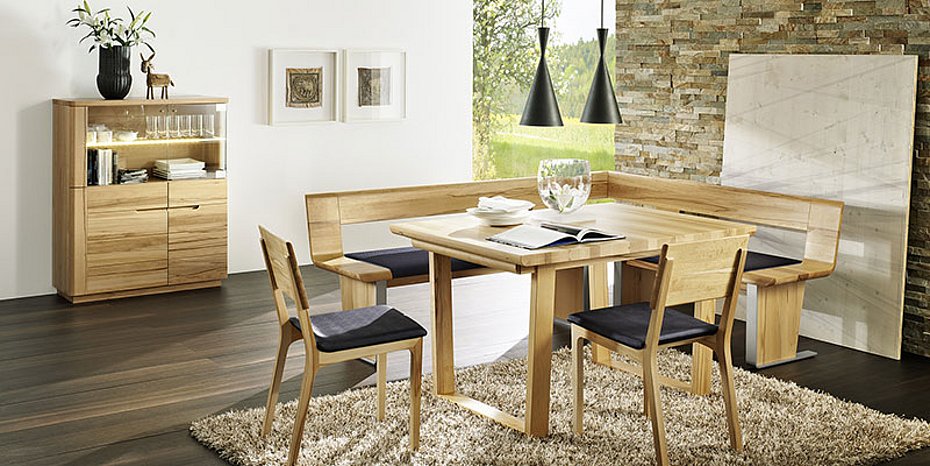
Manuel Mathes: "In my experience, the effort involved is usually much less than previously feared, as most of the existing infrastructure can continue to be used. At Adler, we see ourselves as a problem-solving partner for our customers. Not only do we provide them with top-quality water-based paints, our technical sales team also supports them throughout the entire conversion process: we look at the painting area together and advise customers on what changes are necessary, we train the team in the use of water-based paints - and if painting accessories are still required, customers can purchase them directly from Adler."
Manuel Mathes: "Stainless steel spray guns are needed for water-based paints - but this is largely standard nowadays anyway. We usually recommend buying a new spray gun with hoses and using the old spray gun if a solvent-based paint has to be used from time to time. In addition, a new set of nozzles - slightly larger nozzles are required for water-based paint - and a coagulation set to separate solids from the water-based paint residues. The costs for all these purchases are in the low four-figure range."
Manuel Mathes: "Water-based paints are somewhat more sensitive when it comes to temperature and humidity. A room temperature of 20 to 25°C and a humidity of between 40 and 65% is ideal. Often this room climate already exists and nothing needs to be changed. In other cases, small measures are sufficient - such as a fan or humidifier, which also provide the necessary air movement. Of course, there is plenty of scope to go higher, right up to modern drying cabins or infrared drying - but the changeover is also possible with very simple means."
Manuel Mathes: "The difference to solvent-based paints is only slight with modern water-based paint systems. Bluefin Unistar from Adler can be sanded and recoated after just two hours and is therefore on a par with most solvent-based paints. Other water-based paints, such as the Bluefin Pigmores 4in1 color paint or the Bluefin Softmatt clearcoat, as well as the versatile Arova Flex water-based stain, take between 4 and 5 hours."
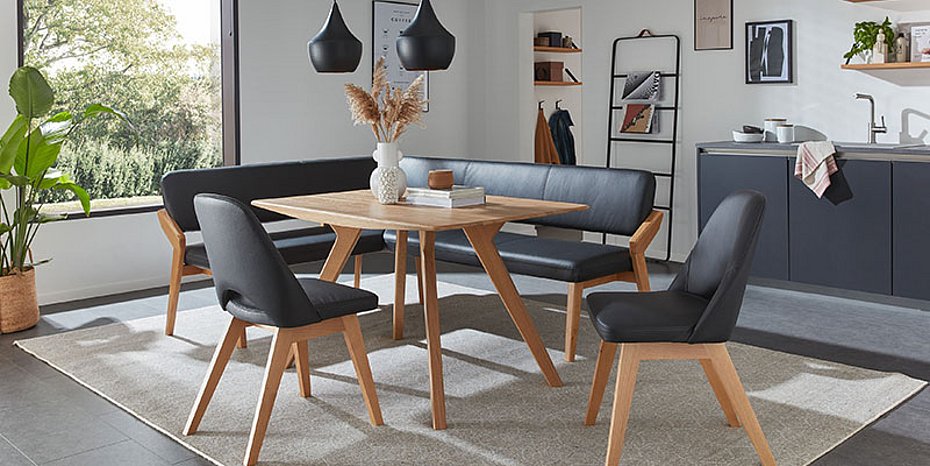
Manuel Mathes: "Not very much, basically you just have to pay attention to a few points. The glue used must be compatible with water-based varnishes, and with woods rich in ingredients, such as oak, you need a suitable clear varnish. In addition, solid oak should be soaked beforehand when using water-based stains in order to prevent the wood fibers from raising. Finally, the crucial point is to ensure the correct application quantity, i.e. to apply less material than you are used to with solvent-based products - an incorrect application quantity is the most common cause of painting errors. All of this can easily be learned in a day or two. At Adler, we offer a separate seminar on this at our service centers - or we come directly to the company and train the employees on site."
Manuel Mathes: "In most cases, this question doesn't even arise, as water-based paints are often applied as a single component - which is usually sufficient. The 1K furniture lacquer Bluefin Resist from Adler, for example, has such a resistant surface that it can also be used for kitchen furniture or in hotel and school interiors. This simplifies processing and saves costs. With 2K processing, some water-based paints have a slightly shorter pot life of approx. 5 hours, but this is easily sufficient with a little planning - and the aforementioned Bluefin Unistar even has a pot life of a full 3 days thanks to an innovative cross-linking technology!"
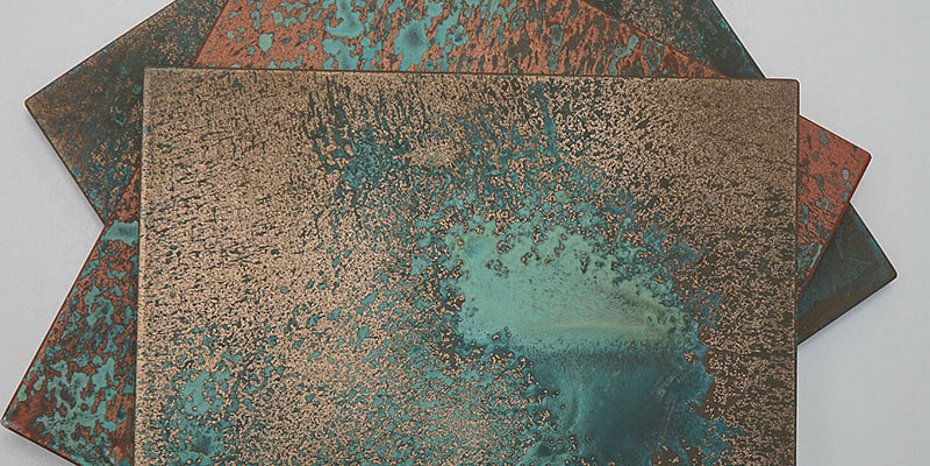
Manuel Mathes: "There are still stories circulating in many companies about water-based paints that soften or turn yellow when touched frequently, for example. This may have happened 30 years ago, but it is no longer an issue with modern systems. As far as Adler products are concerned, I can guarantee that there are no differences in quality, neither in chemical and mechanical resistance nor in color stability. Adler's extensive range includes water-based paints for every area of application, every substrate and every desired look - right through to effect paints such as our real metal coatings."
Manuel Mathes: "When it comes to oils, solvent-based products are still very popular, even with water-based paint applicators. This is not a problem in practice, as oils are usually applied by hand anyway and do not fall under the Decopaint guideline due to their low layer thickness. However, water-based oils such as our Legno Aqua oil are also becoming increasingly popular - this product can also be sprayed and perfectly preserves the raw wood character of reclaimed wood, for example, thanks to its low grain accentuation. Incidentally, water-based varnishes also usually have a lower grain accentuation, which is very much in line with the current trend towards natural, matt surfaces. And if a strong grain accentuation is required, there are also suitable solutions - the Aquafix UV 100 additive, for example, not only offers excellent yellowing protection, but also increases the grain accentuation in all standard water-based paints from Adler."
Manuel Mathes: "Exactly - but there are many advantages: You save costs and don't have to worry about the risk of fire in the paint store. Processing is safer and more pleasant, the aggressive solvent odor disappears. The natural material wood is given a suitable ecological coating, which customers also appreciate. And, of course, the switch to water-based lacquer is the only right way to protect the environment and the climate!"
Contact
Adler-Werk Lackfabrik
Johann Berghofer GmbH & Co KG
Bergwerkstr. 22
6130 Schwaz (Austria)
Tel.: +43 5242 6922
E-mail: info@adler-lacke.com
www.adler-lacke.com
About Adler Lacke
With around 670 employees, Adler is Austria's leading manufacturer of varnishes, paints and wood preservatives. Founded in 1934 by Johann Berghofer, the family business is now managed by Andrea Berghofer, the third generation of the Berghofer family. 22,000 tons of paint leave the factory in Schwaz every year and go to customers in over 30 countries worldwide. Adler has sales companies in Germany, Italy, Poland, the Netherlands, Switzerland, the Czech Republic and Slovakia.