

Dürr has built a paint shop for one of the Volkswagen Group's largest production facilities with the aim of reducing CO2 emissions to a minimum. The plant in Puebla, Mexico, was inaugurated in January 2025. The turnkey project comprises two identical paint lines, which are particularly environmentally friendly thanks to their electrified equipment, such as the electrically powered drying system. With a high-bay warehouse and driverless transport systems, Dürr is also implementing key components of its newly developed "paint shop of the future" concept.
Since January 2025, 90 car bodies of different models have been painted per hour at the Volkswagen plant in Puebla. Dürr was awarded the contract for this in 2022. The new paint shop is designed to integrate additional models and new technologies into the high-volume production with high hourly output in the future. This is made possible by a central high-bay warehouse and the EcoProFleet driverless transport system. DXQ software controls the AGV (Automated Guided Vehicle), which was specially developed for paint shops, in such a way that, in conjunction with the high-bay warehouse, it sorts the bodies in advance and brings them precisely to the right workstation or picks them up again from there. Splitting up rigid production lines is a central component of the Dürr concept of the "paint shop of the future" and shortens the overall process thanks to the process time that is precisely tailored to the individual vehicle. This in itself significantly reduces CO2 emissions.
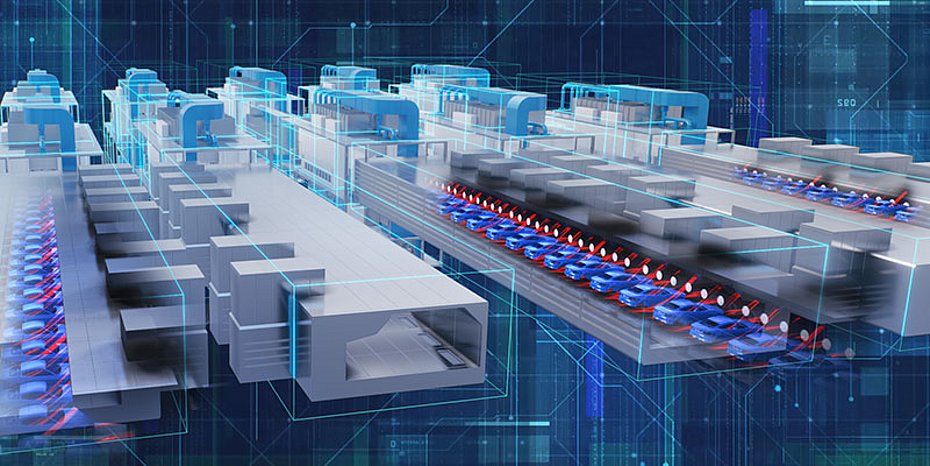
Painting technology for high model variance
The two identical painting lines will house a total of around 170 sealing and painting robots with the corresponding application technology, which will seal and coat various Volkswagen models in the future. Among them is the EcoRS Clean F, which is a good example of how Dürr is further developing plant technology to equip it for the increasing variety of models. It combines the thorough, gentle cleaning of a cleaning system with spring rollers with the high maneuverability of a robot. This makes it predestined for lines in which many body variants with complex contours are painted. The order volume also includes the complete paint and PVC supply as well as software solutions with AI applications from the DXQ product family developed by Dürr.
Significant reduction in CO2 emissions
The key component for reducing CO2 emissions is body drying, as it consumes the most energy in the painting process. However, if the dryers are operated with renewable energy such as green electricity, the CO2 emissions of the entire system are reduced by around 40 percent compared to a natural gas-powered paint shop. "That was one of the reasons why Volkswagen opted for the electrically powered EcoInCure drying system," says Bruno Welsch, COO of the Automotive division at Dürr. "Added to this is its special air flow, which heats the car bodies from the inside out. This technology leads to a more even heating and cooling behavior and reaches solid body components such as the sills more directly than conventional systems. This in turn reduces the heating times of the bodies by around 30 percent."
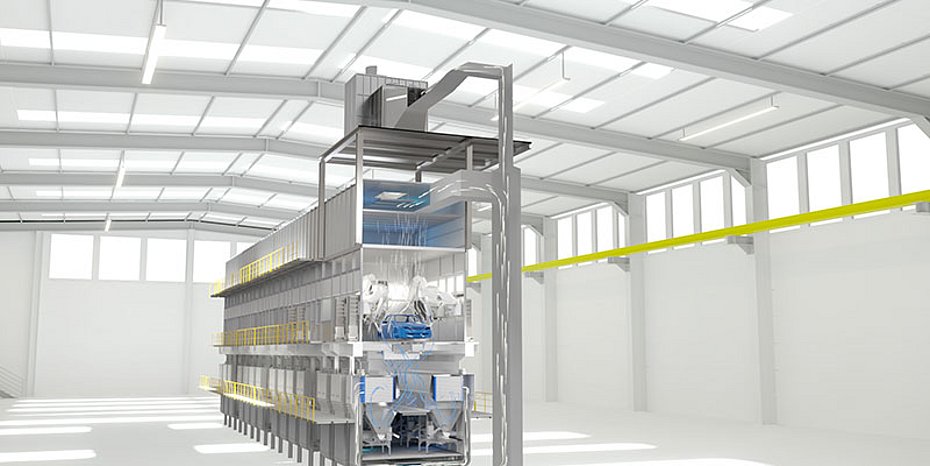
Overall electrical concept for dryer and exhaust air purification
Another way to minimize CO2 is to combine the electric dryer with an electrically operated exhaust air purification system. Dürr is the only supplier on the market with such an overall concept. It combines EcoInCure with Oxi.X.RV, an electric exhaust air after-treatment system that uses the principle of regenerative thermal oxidation (RTO) to clean the polluted exhaust air - without an open flame. In contrast to conventional combustion processes, no additional CO2 is produced during operation. The system is also very energy-efficient and achieves autothermal operation even with small quantities of solvent, i.e. it maintains its operating temperature automatically. To do this, it uses the large amount of energy generated during the oxidation of the solvents to keep its process running.
Dürr also installed a particularly energy-saving, environmentally friendly system for paint separation. EcoDryScrubber separates paint overspray using limestone powder as a natural binding agent. Highly efficient HEPA12 filters ensure particle-free process air. The saturated limestone powder is extracted fully automatically via a pipe system without interrupting the process. Dry separation enables a particularly low fresh air supply and a correspondingly high proportion of recirculated air. At the plant in Puebla, the proportion of fresh air is minimized to 5 percent. The energy savings compared to conventional wet separation are therefore well over 60 percent (OM-9/25).
Contact
Dürr AG
Carl-Benz-Str. 34
74321 Bietigheim-Bissingen (Germany)
Phone +49 71 42 78 0
E-mail: c orpcom@durr.com
www.durr.com
About Dürr
The Dürr Group is one of the world's leading mechanical and plant engineering companies with strong expertise in the areas of automation and digitalization/Industry 4.0. Its products, systems and services enable highly efficient and resource-saving manufacturing processes in various industries.