
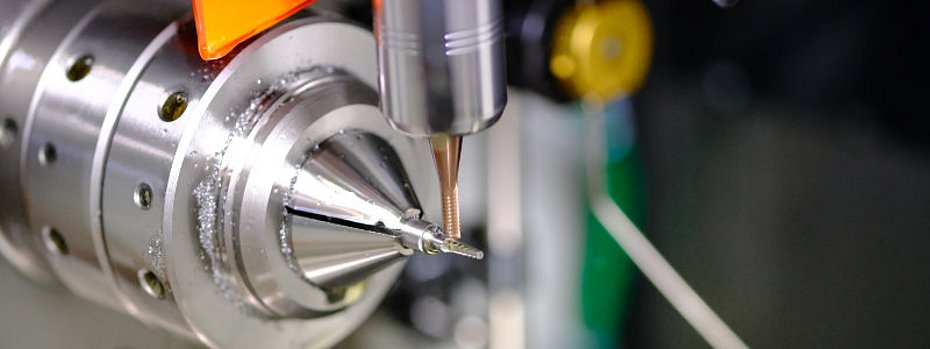
In collaboration with CemeCon, tool manufacturer HPTec has developed the RQR 350 milling cutter, which has a diameter of just three millimeters and features an InoxaCon coating. This “miracle tool” for micro-machining in medical technology ensures uncompromising machining quality and an exceptionally long service life. This makes it ideal for a stable, precisely reproducible manufacturing process that can run reliably and automatically overnight.
A steady hand isn’t everything: Since surgical instruments are used directly inside the human body, the requirements for their surface quality, burr-free finish, and dimensional accuracy are particularly critical. This has been a matter of course for Bacher Medizintechnik GmbH for decades as a manufacturer of instruments for endoscopy and minimally invasive surgery. At the same time, cost-effectiveness is essential in component manufacturing: When machining so-called “jaw parts”—functional instrument gripping heads for grasping or cutting tissue—the Baden-Württemberg-based company therefore relies on manufacturing processes that run automatically for many hours. Even during unmanned production, continuous in-process inspection is, of course, carried out throughout the entire process. An integrated 3-D probe system, supplemented by laser measurement, continuously monitors the relevant geometries, ensuring that the required quality is maintained at all times—even during automated night shifts. Another significant aspect is the performance of the machining tool. After all, “In medical technology, there is absolutely no room for fluctuating quality,” explains Mate Bekavac, Head of CNC Manufacturing at Bacher Medizintechnik. “Especially with batches that run overnight unmanned—that is, without the possibility of direct intervention—I have to be able to rely 100 percent on the tool to operate fail-safely right down to the last jaw piece and ensure that no scrap is produced.”
Challenge: Rough machining with diameters up to three millimeters
The requirements for the partner, HPTec, were thus clearly defined—the tool manufacturer was to develop a roughing tool with a long service life and consistently high sharpness to ensure consistently stable, high-quality machining. A particular technical challenge was that only a very small tool diameter—a maximum of 3 millimeters—was permitted. Nevertheless, the required high-performance cutting tool had to withstand high forces and remove a large amount of material in a short time.
The first step toward a solution was a targeted optimization of the tool geometry by HPTec: The developers quickly achieved a balanced ratio of core diameter, chip clearance, and cutting geometry, ensuring stability while also enabling efficient chip evacuation. The design is complemented by a special roughing-finishing tooth profile. It produces short chips and, when properly coated, achieves an exceptionally uniform surface finish as early as the roughing process.
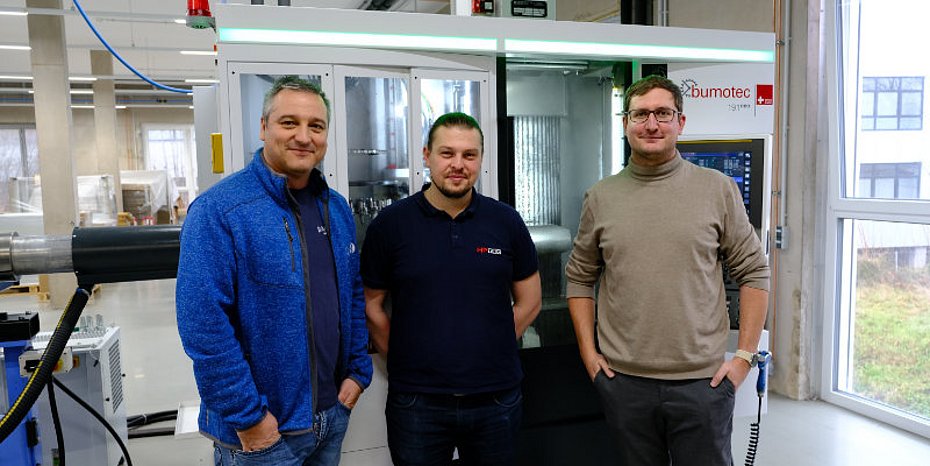
Optimal tool coating complements optimal tool geometry
A key performance factor of the new RQR 350 milling cutter is the HiPIMS coating from CemeCon. During the joint development phase, the coating specialist and the tool manufacturer HPTec designed a coating that gives the cutting edge an exceptionally high and long-lasting sharpness. The basis for this is the extremely hard and temperature-stable TiAlSiN-based coating material InoxaCon. Thanks to CemeCon’s many years of experience with HiPIMS, the coating could be tailored to also support the tool’s long-term stability, thereby significantly extending its service life.
“With this innovative micro-milling cutter, we’re already achieving excellent surface quality during roughing with a minimal allowance of no more than 0.05 millimeters, which allows us to perform the subsequent finishing process with a very small cutting width,” says Bekavac. “This significantly reduces cutting forces and thus the load on the finishing tool, minimizes burr formation, and has a positive impact on the entire process.” Julian Reck, Key Account Manager at HPTec GmbH, adds: “Especially in micro- and fine-machining, it is crucial that the coating does not ‘round off’ the cutting edge.” CemeCon has specified the HiPIMS coating for us in such a way that this is precisely what is achieved: high hardness, excellent adhesion, and a layer thickness and homogeneity that optimally complement the carbide substrate and the tool geometry.” The result is a tool life that, in practice, is many times longer than that of the competing tools previously used—while maintaining consistent machining quality throughout the entire service life.
For Bacher Medizintechnik, in addition to this extended tool life, it is above all the 100% reliable process reliability that provides the decisive advantage. A wear-related decline in quality during unmanned production would result in unnoticed scrap—and thus high costs. “The new tool gives us the assurance that the jaw components will still meet the exact quality requirements even after many hours of automated production,” says Bekavac.
HPTec
Since 1977, HPTec has been manufacturing high-precision tools of exceptional quality and reliability for the machining industry. From its production facility in southern Germany, a team of approximately 80 dedicated employees supplies customers worldwide with innovative, comprehensive, and application-specific solutions.
In addition to a diverse product range and technical support, HPTec offers a range of services. These include regrinding and ring-fitting of tools, as well as customized solutions for customers’ tool management. Furthermore, HPTec offers a CNC prototyping service for sample production or small-batch runs.
Technical excellence and collaborative development open up new possibilities
The project clearly demonstrates how close collaboration between the user, the tool manufacturer, and the coating specialist leads to measurable success. For HPTec, the tool developed in collaboration with CemeCon also represents another important step into a strategic growth market. The company’s many years of experience in manufacturing high-precision tools for the printed circuit board and dental industries—including as an OEM—translated seamlessly to the demanding field of medical technology. The expertise gained—ranging from precision engineering to reliable process stability and strict quality requirements—provided an ideal foundation for developing innovative, robust solutions in medical technology that are precisely tailored to specific applications.
“For us, projects like these are more than just product development,” emphasizes Wolfgang Würtz, Head of Sales and Marketing at HPTec. “They demonstrate how we can tap into new markets and strategically expand our technological expertise in collaboration with strong partners.” The combination of optimized tool geometry, high-performance HiPIMS coating, and close user integration makes this flagship project a solid blueprint for further applications—even beyond medical technology: wherever precision, process reliability, and cost-effectiveness must come together. (OM-7/26)
Contact
CemeCon AG
Adenauerstraße 20 A4
52146 Würselen (Germany)
Phone: +49 2405 4470 100
Email: info@cemecon.de
www.cemecon.com