

In addition to many other influencing factors, precise milling processes also determine the quality and efficiency of production in the metalworking industry. This is because even small errors such as incorrect speeds or excessive contact pressure can have serious consequences during milling. Some typical sources of error in machining and practical solutions are presented below in order to raise awareness of this important topic among all those involved, to support optimum process reliability - and thus to permanently achieve a high surface quality during milling and extend tool life. One basic requirement that must always be met is the use of high-quality tools, such as those offered by Lukas-Erzett to its customers.
The ideal case: when man, tool and machine work together perfectly
Precision is often the be-all and end-all when machining metals - and this can only be achieved through the smooth interaction of man, machine and tool. Even slight deviations in the cutting conditions or minor operating errors can have a major impact: The quality of the machined surface decreases, the tool wears out more quickly and, in the worst case, production delays or rejects occur. Vibrations during the milling process are a common cause. They are caused, for example, by unstable clamping, incorrect cutting speed or unsuitable tool guidance. This means that the tool does not cut continuously, but "plucks" or "tears" the material. The result is rough, irregular surfaces. Advanced tool wear, excessive contact pressure, incorrect milling tools and unsuitable gear teeth also impair the milling quality. But - and this is the good news: with the right choice of tool, optimum speed settings, the correct feed rate and a conscious view of the process, many problems can be avoided from the outset. And achieve results that combine quality and efficiency.
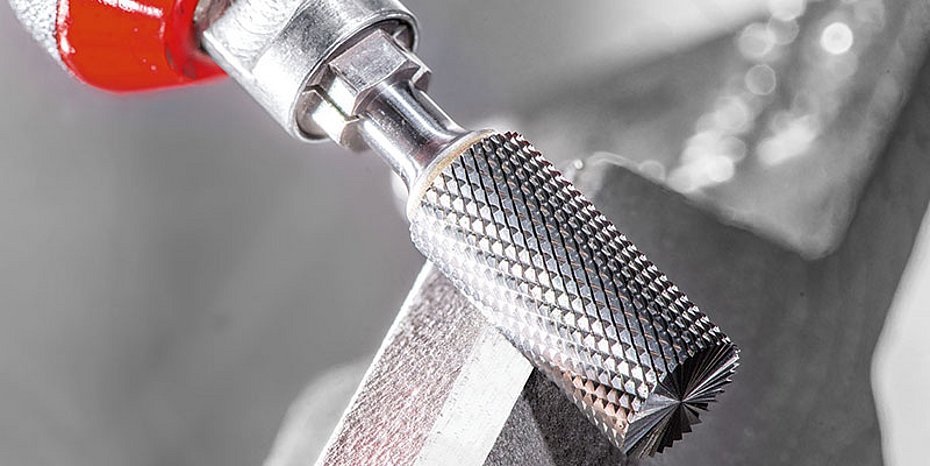
Avoiding milling errors Part 1: Incorrect speed and excessive contact pressure
Incorrect speed is one of the most common errors when milling. If the speed is too high, there is a risk of premature tool wear or even tool breakage; if the speed is too low, the tool can "eat" into the material or get stuck abruptly. An incorrect cutting speed also increases the risk of a built-up edge, for example. The consequences are clear: lower quality, more frequent tool changes. As the development of milling tools is also constantly being driven forward - and in order to avoid errors, it is always worth taking a look at the manufacturer's specifications for the respective milling tool. This ensures that the milling cutter is suitable for the material and that work is carried out at the optimum cutting speed. This is because the correct speed enables more even processing, which ultimately improves the surface quality and extends the tool life.
Another avoidable mistake is applying too much pressure when milling manually, for example when deburring with burrs. Excessive pressure encourages the milling cutter to dig into the workpiece too aggressively. This results in irregularities on the surface, including burrs or discoloration due to excessive heat. In the worst case, the workpiece material can break or chip. There is also an increased risk of the milling cutter being damaged or breaking.
Modern routing tools such as Lukas carbide burrs with sharp teeth cut very efficiently with little effort. And an appropriate, even contact pressure provides more control over the milling process and at the same time protects the machine and milling cutter. In other words: the right milling cutter, the right speed and light pressure will get you there faster than brute force. If higher removal rates are required, a coarser toothing or a more powerful machine is recommended instead of excessive pressure.
Avoiding milling errors Part 2: unfavorable cutting angle and vibrations
An incorrect cutting or wrap angle (e.g. if a burr is set too flat or over the entire surface) leads to too many cutting edges being engaged at the same time. This usually results in vibrations (chattering) and greatly reduced chip removal. The surface then shows grooves and is not even, as the cutter is deflected by the vibrations. This can also lead to faster tool wear as the cutting edges are unevenly loaded. In practice, this means: Ensure a favorable cutting angle and a suitable cutting strategy. For example, when milling an edge, the burr can be guided at a slight angle or offset so that only part of the cutting edge is engaged at any one time. This distributes the cutting forces more evenly and the router runs more smoothly.
The choice between climb milling and up-cut milling also influences stability: In many cases, climb milling results in less vibration as the cut is smoother. Stable clamping of the workpiece is also important: A firmly fixed workpiece and a precisely clamped milling cutter minimize vibrations. If vibrations do occur, slight adjustments to the speed or feed rate can help to break through the resonance. Often, even a slight increase or decrease in speed can stop the chattering. The result: a smoother process with a higher surface quality and a longer tool life.
Avoiding milling errors Part 3: Worn or unsuitable tools
Even when used optimally, every milling tool is subject to natural wear. A blunt milling cutter no longer cuts properly, but increasingly rubs against the material. This causes high frictional heat and requires more contact pressure, which in turn worsens the surface quality and puts a strain on the machine. Typical signs are dull, rough surfaces and often a higher noise level during milling. In addition, the risk of burr formation at the edge of the workpiece and dimensional inaccuracies increases. Worn cutting edges also increase the risk of damage: A heavily worn router bit can break unexpectedly. The service life of the tool has then long been exceeded, which is why you should replace burrs and milling cutters in good time or have them resharpened before the quality of the workpieces suffers.
The investment in a new or sharpened milling cutter pays off thanks to more consistent results and reduced scrap costs. Also use suitable cutting materials: For metal cutting, burrs made of carbide (HM) are now standard, as they offer a much higher hardness and service life than HSS burrs. HSS tools are more suitable for softer materials or occasional use, while carbide burrs remain durable even at high speeds and in hard materials. Therefore, always make sure to select a milling cutter that is suitable for the material. This is because an unsuitable tool not only wears out more quickly, but can also lead to heat problems, material damage and poorer results overall. In short: With sharp tools that are suitable for the application, you will achieve higher quality machining results and significantly reduce downtimes.

Avoid mistakes - with milling tools from Lukas-Erzett
One of the best strategies for avoiding errors is high-quality tools. Lukas-Erzett offers its customers a wide range of milling tools - from carbide burrs and HSS milling cutters to specially coated versions - which minimize typical milling errors from the outset. LUKAS carbide burrs are characterized by precisely ground cutting edges and stable steel shanks.
At the same time, sophisticated toothing, such as the proven cross toothing, enables a high removal rate with little effort. This means that the operator has to exert less pressure, the cutter literally "bites" itself into the material. This prevents chattering and makes work faster. Even hard and tough materials can be cut effortlessly with these burrs. Lukas-Erzett also relies on innovative hard material coatings for milling tools to counteract common errors. For example, a TiAlN-based HeavyDuty coating increases wear resistance enormously, which prevents premature dulling, especially at high temperatures and with hard materials. Another development is the LightFlow coating with lotus effect: it reduces friction and prevents material from sticking to the cutting edges. Built-up edges and sticking are avoided. The result: The milling cutter remains sharp for longer and the surface quality is first-class. In addition, a suitably coated milling cutter runs much more smoothly. The tool requires little force and runs without chattering or vibrations. This contributes to a longer service life for both the tool and the machine.
Good advice - success with high-quality Lukas tools
Quality in machining begins with the choice of the right tool. In other words, with tools that are optimally matched to the intended tasks and requirements - and thus that the specific application specifications are adhered to. In this way, typical milling errors can be actively avoided. The experts at Lukas are happy to answer individual questions and provide expert advice by phone or e-mail. (OM-6/25)
Contact
Lukas-Erzett GmbH & Co. KG
Gebrüder-Lukas-Straße 1
51766 Engelskirchen (Germany)
Phone: +49 (0) 22 63 84 - 0
E-mail: le@lukas-erzett.de
lukas-erzett.com
About Lukas-Erzett
As one of the technologically leading manufacturers of system solutions for milling, grinding, polishing and cutting, Lukas-Erzett GmbH & Co. KG, based in the greater Cologne area in the Oberberg district, specializes in the manufacture, trade and consulting of grinding, milling, polishing and cutting tools, drive machines and an extensive range of accessories.