

Umicore's Metal Deposition Solutions business unit has developed an innovative and environmentally friendly platinum coating process for titanium components in electrolysers. This technology significantly improves occupational safety during wet chemical coating of the components, as it does not require the highly corrosive or toxic chemicals that were previously necessary. Umicore is thus replacing the previous standard and ensuring more sustainable hydrogen production. The business unit has set up specially equipped production facilities worldwide for this particularly precise and therefore also economical coating process.
At a time when the energy transition and the need for sustainable energy sources and storage are becoming increasingly urgent, hydrogen plays a central role as an energy carrier of the future. Among the possible processes for hydrogen production, proton exchange membrane electrolysis (PEM) has established itself as an efficient method. In contrast to the alternative alkaline electrolysis, which reacts less flexibly to volatile energy quantities (load fluctuations), PEM electrolysis can react quickly to changes in the electricity supply, making it ideal for integration into renewable energy systems and thus for the production of green hydrogen.
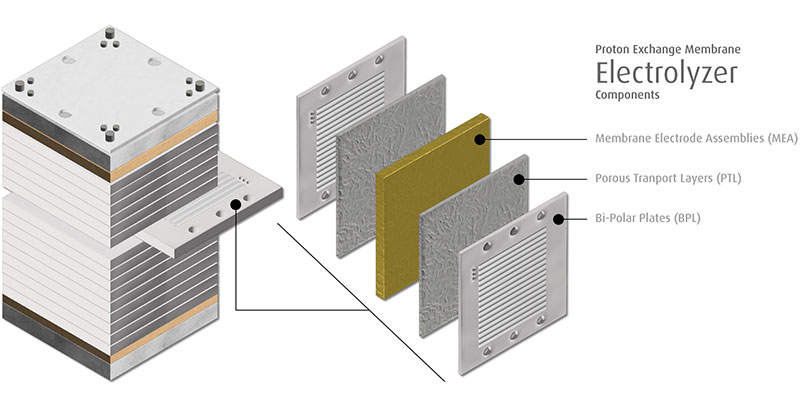
Material crucial for PEM electrolyzers
In order to withstand the demanding conditions of PEM electrolysis, titanium is used as the base material for Umicore Metal Deposition Solutions coated bipolar plates (BPL) and porous transport layers (PTL) for PEM electrolyzers. In contrast to stainless steel variants of bipolar plates (BPL) and porous transport layers (PTL), titanium is significantly more resistant in the acidic and oxidizing environment of PEM electrolysis. It also helps to maintain conductivity and adapt to high-pressure environments, which is crucial for the longevity and cost-effectiveness of electrolyzers.
The platinum coating of the components is at least as important. On the BPL side, the coating contributes significantly to the longevity due to its corrosion resistance. Above all, however, platinum improves the performance of the electrolyzers many times over by acting as a catalyst and increasing the efficiency of the electrochemical reactions. It enables a superior electrical potential for the PTL and helps to reduce the amount of energy required for water splitting. This is particularly beneficial when the electrolyzer is powered by renewable energy, enabling the production of green hydrogen.
Titanium is a refractory metal that forms corrosion-resistant oxide layers at room temperature. This property makes it difficult to deposit platinum on BPL and PTL made of titanium. For this reason, highly corrosive or toxic chemicals such as hydrofluoric acid have traditionally been used for coating in order to break down the passive oxide layers that form on titanium and generate sufficient adhesion for platinum.
Due to its highly toxic and corrosive properties, the above-mentioned hydrofluoric acid can cause serious damage to health, including severe burns, eye damage and respiratory problems, in the event of direct contact or inhalation. In addition, its use requires strict regulations and special storage containers to ensure the safety of employees and the environment. Together with the additional bureaucracy this requires, the use of such substances can no longer be reconciled with sustainability goals for a growing number of companies.

Know-how for a safe process
In contrast to the conventional hydrofluoric acid process, Umicore therefore relies on a specially developed and highly innovative electrochemical deposition process that makes the use of such hazardous chemicals for platinization superfluous. Umicore has succeeded in reproducing and scaling up a qualitatively equivalent and durable bond between the substrate material and the platinum layer under new process conditions.
As Umicore's platinum coating is technically mature, the advanced process can also be used to deposit very thin, homogeneous platinum layers with high precision on titanium components which, due to their matrix state, achieve the best possible electron conductivity and therefore outstanding efficiency. In addition, an optimum layer thickness distribution is guaranteed for the respective system. This helps to reduce the use of precious metals and thus the costs for this compared to previous coating processes, which quickly has a positive effect, especially for large quantities, and thus creates the conditions for industrial scalability.
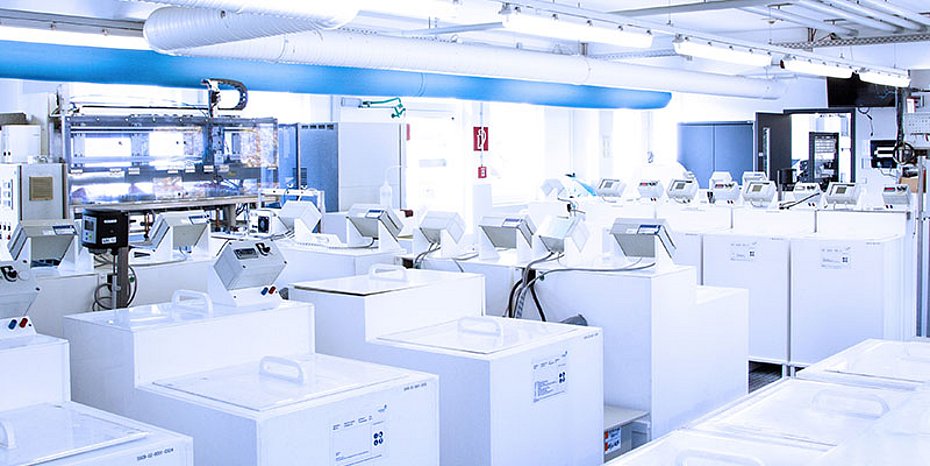
Electroplating centers at the key locations
Contrary to the previous business principle, the company decided to carry out the coating exclusively itself and not to leave it to the customer via the usual electrolyte sales. "We decided to take this step due to the complexity of the process and, above all, the spatial requirements. We see plating - especially in this case - as our core competence and take it on for our customers with the aim of achieving the best possible platinum coating," says Sebastien Fourgeot, the responsible project manager, explaining the rather unusual approach for the company.
Umicore MDS has therefore adapted its electroplating centers worldwide accordingly in order to be able to carry out the coating of components at any time in relative proximity to the customer and thus without long transport routes. These centers are at least partially automated and scalable, so that even large order quantities can be processed efficiently and therefore economically in a short time. (OM-9/24)
Contact
Umicore Galvanotechnik GmbH
Klarenbergstraße 53 - 79
73525 Schwäbisch Gmünd (Germany)
Phone: +49 (0) 7171 607 - 01
E-mail: galvano@eu.umicore.com
mds.umicore.com
About Umicore Metal Deposition Solutions
The Umicore Business Unit Metal Deposition Solutions (MDS) is the business center within the Umicore Group for the two established business units Electroplating and Thin Film Products. Metal Deposition Solutions is one of the world's leading suppliers of products for the (precious) metal-based coating of surfaces in the nano and micrometer range - with the expertise of the two business units, the company combines the two highest quality processes: Electroplating and PVD coatings.