
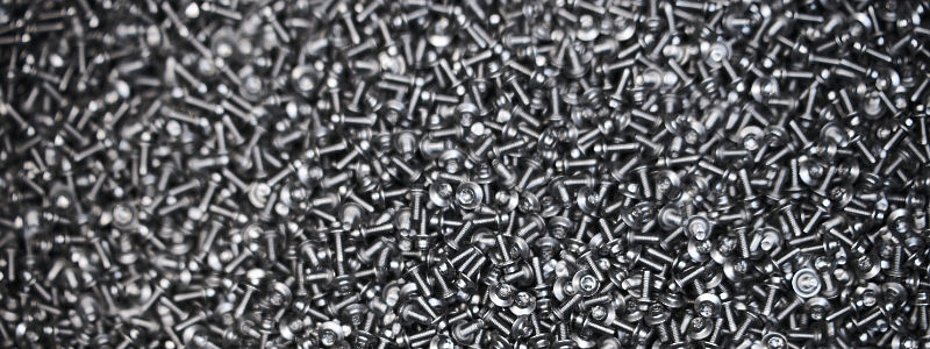
Screws, as removable fasteners, are available in many application-specific designs. Whether for automotive or industrial use in construction or electronics, screws are in demand everywhere. To ensure a functional surface, electroplating of steel screws remains the method of choice for producing high-quality screws in large quantities. To ensure a reliable coating, the electroplating baths must always be maintained within the correct concentration range. Chemical-resistant pumps with dosing capabilities make a significant contribution to this process thanks to their simple and safe operation.
To ensure that screws can withstand adverse environmental conditions over the long term, a durable surface is crucial. Ejot, a medium-sized group of companies in the metalworking industry and a European market leader in fastening technology, relies, among other things, on the electroplating of screws to achieve this. Until now, to ensure reliable operation of the electroplating process at the plant in Bad Laasphe, the baths had to be regularly “refreshed”—that is, replenished—manually with new chemicals. Now, chemical-resistant magnetic centrifugal pumps with a dosing function simplify this step while improving both workplace safety and the process’s cost-effectiveness.
Complex Screw Finishing
Electrochemical metal deposition, also known as “galvanizing,” involves several steps before the final result is achieved. At the electroplating facility in Bad Laasphe, the screws first undergo various pretreatment stages: descaling, hot degreasing, and pickling. They are then further cleaned through electrolytic degreasing and decapitation—that is, the neutralization of any adhering acids or alkalis. For the actual galvanizing process, they are then immersed in a zinc-acid or a zinc-nickel electroplating bath. Each of the two electroplating baths has a volume of approximately 20,000 liters and over 15 coating stations. This is followed by heat treatment and post-treatment using one of four media options to produce blue, thick-film, transparent, or black surfaces. The finishing process is then completed with a sealing or anti-seize coating applied to the surfaces.
Managing Corrosive Substances
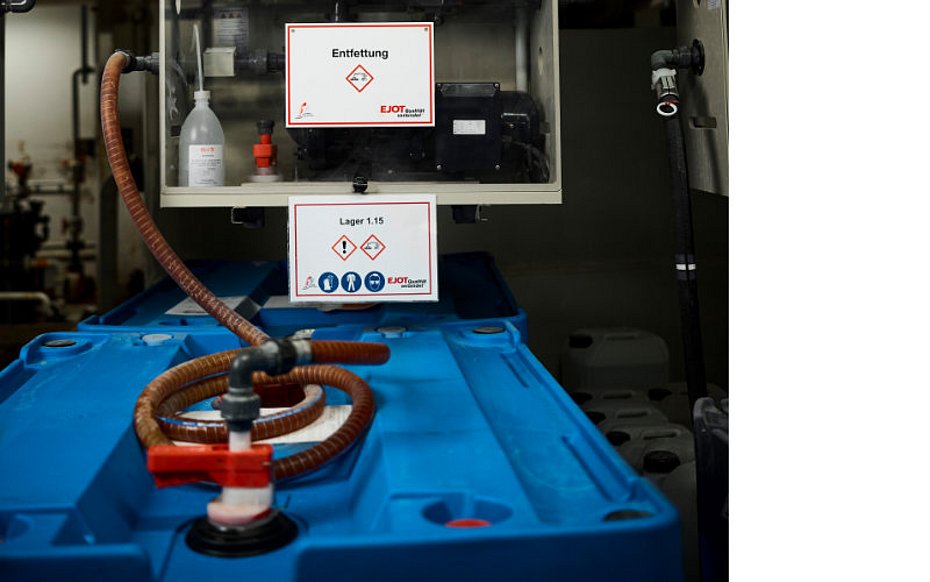
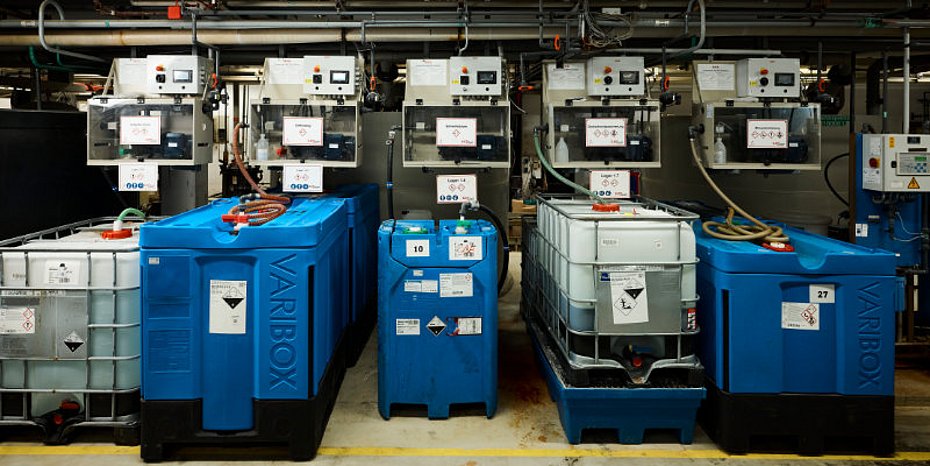
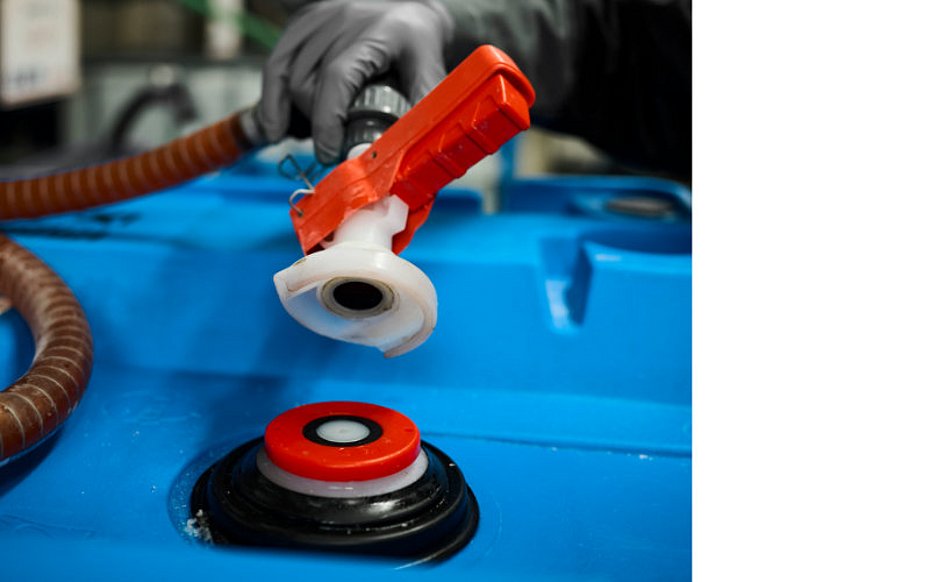
Previously, employees dispensed corrosive wet chemicals—such as sulfuric and nitric acid, as well as caustic soda—for the numerous laboratory-monitored baths individually from canisters or IBCs. In both cases, they came into direct contact with the substances and were exposed to splashes or vapors. Transporting the chemicals from the basement upstairs was a difficult task, despite good ventilation and protective equipment. In addition, handling single-use IBCs resulted in high disposal costs. Ejot was therefore looking for a solution that had to meet three objectives: To improve workplace safety, employee contact with the chemicals needed to be avoided. Furthermore, automating the dosing process would reduce potential sources of error. And last but not least, operating costs were to be lowered through the use of durable, sealed, and larger containers. Instead of disposing of empty IBCs, the Varibox IBC system is now used; it is hermetically sealed and thus delivered by the chemical supplier as part of a closed-loop system. Since Variboxes are double-walled, a spill containment tray is not required during storage. This also eliminates the annual inspection costs for the spill containment trays.
Hermetically sealed and secure
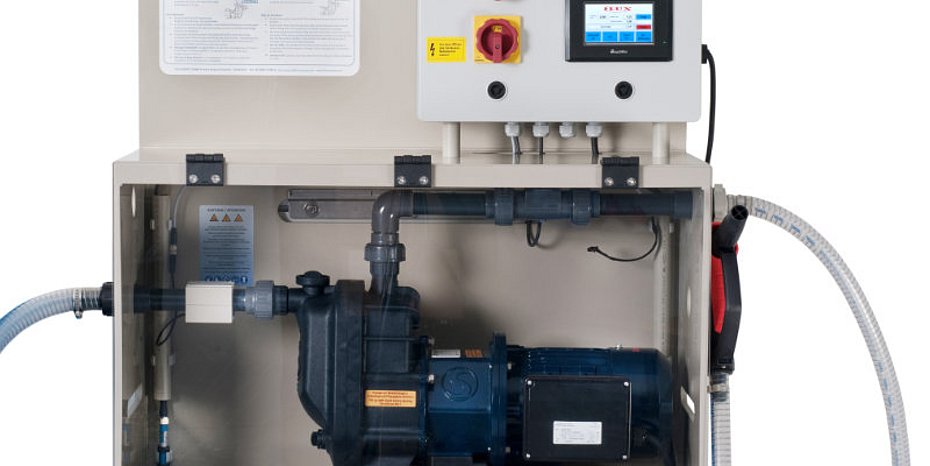
Flux’s modular Safetec pump set is used to ensure the safe removal of chemicals. It consists of magnetically coupled centrifugal pumps housed in a compact console with integrated leak detection (Figure 3). Ejot uses five different Safetec systems in the basement, each with materials (ranging from PVC to ETFE) tailored to the specific chemicals. The pumps deliver fluid at pressures of up to 1.3 bar and can safely handle media up to 60 °C. Each pump is connected to the appropriate container via a hose line and a dry coupling. The couplings reliably prevent the medium from leaking during connection or disconnection and eliminate any contact with the medium when changing containers. The containers are then emptied using the self-priming centrifugal pump via a suction lance. Depending on the container type, either a conventional IBC suction lance or the Varibox’s integrated suction lance is used for this purpose.
Thanks to its magnetic drive without a shaft seal, the pump itself is hermetically sealed and operates maintenance-free. A drip pan in the console collects any liquid resulting from potential leaks in pipes or fittings. For dosing, a non-contact ultrasonic flow meter—which operates without coming into contact with the media and is therefore wear-free—monitors the flow rate. The pump, console, and piping thus form a reliable delivery system with minimal maintenance requirements and low lifecycle costs.”
Streamlined Workflow and Greater Process Reliability
Chemicals are pumped from the basement to the ground floor and into the electroplating baths via pipes. Solenoid valves integrated into the pipes act as backflow preventers when the pumps are shut down. Instead of having to carry heavy loads, the employee sets the desired quantities using the touch panel, and everything runs automatically. In addition to the panels above the IBC stations in the basement, additional control stations were installed on the ground floor near the baths (Figure 6). This allows employees to monitor all pump data and the electroplating system at a glance at any time. The integrated dry-run monitoring system alerts the operator via the display when an IBC is empty and automatically shuts off the pump. This has significantly simplified the employees’ daily work while simultaneously improving safety, ensuring reproducible dosing, and thereby enhancing the quality of the process. Downtime has also been significantly reduced.
Ejot uses Safetec pump sets in the “Comfort” version with PLC control. Various filling volumes can also be stored on the touch panel with plain-text display and then retrieved with a single click. Alternatively, the system can be set so that the pump continues to dispense until the storage tank is completely empty. The intuitive operation has very quickly become the norm for Ejot employees in their daily work, as it simplifies their tasks and prevents operating errors.

The Right Pump Solution for Every Application
The modernization of chemical dosing in electroplating demonstrates how occupational safety, process reliability, and cost-effectiveness can be effectively combined. By using hermetically sealed pumps with automated dosing functions, screw-type electroplating achieves high reproducibility while reducing operational risks. In addition to the Safetec units used here, Flux also offers simpler models without a dosing function. Alongside stationary systems, the pumps are also available as mobile units mounted on a cart, allowing them to be easily moved to the storage tank. Optional accessories, such as various dry-coupling systems and valves, complement the pump set specifically for different applications. This tailor-made solution for electroplating has won over the screw manufacturer. The company plans to purchase additional Safetec systems in the future. (OM-8/26)
Authors
Louisa Schilling, Campaign & Content Manager (Flux Devices), Andreas Zeiff, M.Sc. in Chemistry (Stutensee Editorial Office)
Contact
Flux-Geräte GmbH
Talweg 12
75433 Maulbronn (Germany)
Phone: +49 7043 101-0
Email: info@flux-pumpen.de
www.flux-pumpen.de
About Flux Pumps
Flux pumps are used, for example, in the chemical, pharmaceutical, and cosmetics industries; in mechanical and plant engineering; and by companies in the fields of surface technology, wastewater treatment, and the food industry, as well as in hazardous areas. Flux-Geräte GmbH supplies pumps to nearly 100 countries.