

Alternative rhodium coating - abrasion resistant and bright white
The surface alloy Rhoduna Alloy has established itself as the standard for an alternative rhodium coating. The electrolyte is characterized by high abrasion resistance and an identical degree of whiteness, as an independent technical committee has now confirmed.
The surface alloy Rhoduna Alloy, already developed by Umicore Metal Deposition Solutions in 2010, has established itself as the standard for an alternative rhodium coating. The reasons why the electrolyte is used by renowned manufacturers worldwide are manifold. First and foremost, the company itself cites the exceptionally high abrasion resistance, the whiteness level identical to pure rhodium, and the clear cost advantage. The qualitative properties in particular have now been examined and impressively confirmed by Francéclat (Paris/France), an independent expert committee for economic development which serves the jewelry industry, among others.

Rhoduna Alloy is more than an alternative
The aim in developing the rhodium-ruthenium electrolyte (composed of 75% rhodium and 25% ruthenium) was to achieve maximum cost savings without compromising on quality. At the same time, the rhodium-ruthenium alloy, similar to pure rhodium, was also to be easily deposited in layer thicknesses between 0.05 μm and 0.2 μm. The Francéclat test report, which has now been published, also provides independent evidence that the targets set have been achieved and that some qualitative properties have actually been further improved.

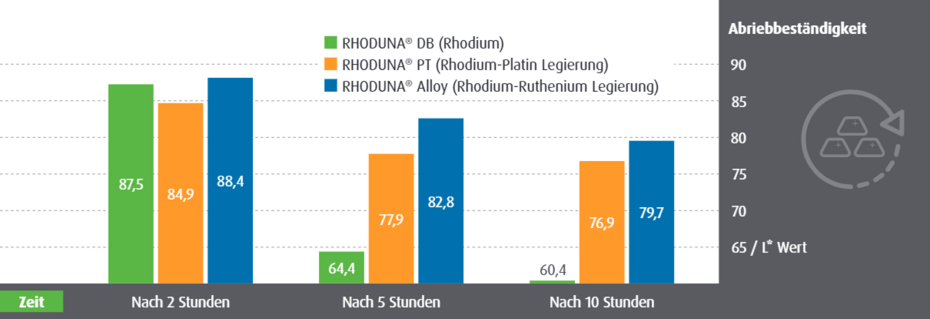
The focus was on the better abrasion resistance of the alloy electrolyte compared to pure abrasion resistance of Rhoduna Alloy, as always claimed by Umicore and proven by an internal Bosch-Weinmann test, confirmed rhodium by the independent Francéclat Professional Committee for Economic Development in Paris (France). However, the committee used the Turbula abrasion test commonly used in the jewelry industry. Here, the L* values (brightness in CIELAB color space) of the 0.1 μm cover layers were checked in two tests on the substrates palladium and ruthenium. After only 2 hours, the first signs of dissolution of the pure rhodium layer were evident from the decreasing L* value, and after 5 hours the layer had been almost completely removed. The L* value was about 30 points lower and thus almost corresponded to the brightness value of the substrate used in each case. In contrast, the Rhoduna Alloy topcoat in the same test run was still largely intact after 10 hours and showed an L* value loss of only 10 points irrespective of the substrate type.
Rhoduna Alloy is visually indistinguishable
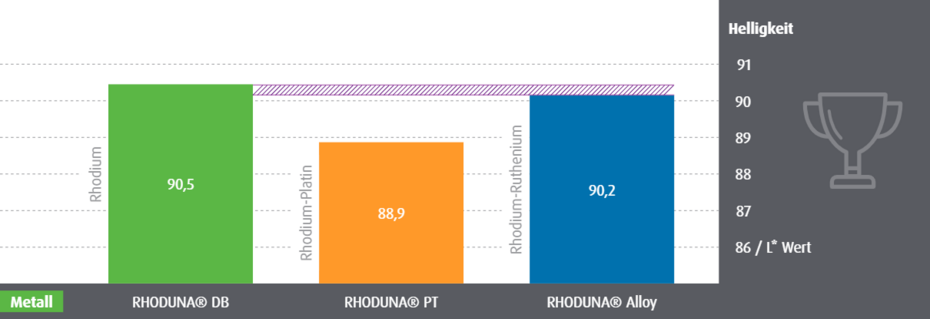
Through targeted electrolyte development, Umicore has succeeded in developing a coating whose whiteness is almost equivalent to that of a pure rhodium coating. Thus, the L* value (whiteness) of the Rhoduna Alloy coatings in the Francéclat test report is only 0.3 points below that of pure rhodium electrolyte coatings. To the naked eye, this marginal difference is not even perceptible to experts.
Further advantages in spreading behavior and economy
For pure rhodium electrolytes, deposition in complex-shaped applications is usually difficult. This is particularly evident, for example, in recesses in jewelry, e.g. for embedding gemstones. The low deposition in these areas results in less bright surfaces, making gemstones appear dull and pale. In direct comparison, Rhoduna Alloy shows significantly better scattering behavior, which has a direct effect on the radiance of the recesses - the application not only appears more valuable, but is also qualitatively so.
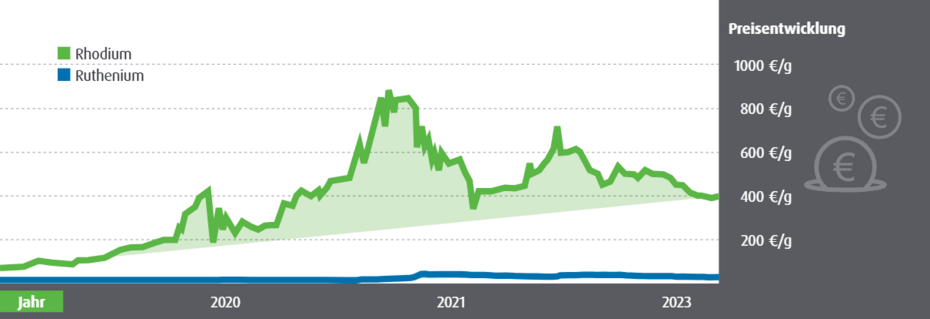
However, Rhoduna Alloy offers more than just qualitative advantages. The alloy partner ruthenium has also been significantly cheaper than rhodium for many years due to deposits and demand, which gives the rhodium-ruthenium alloy a price advantage. Compared with conventional rhodium electrolytes, Rhoduna Alloy thus offers a cost saving of around 25 percent.
Rhoduna Alloy is also interesting for technical applications
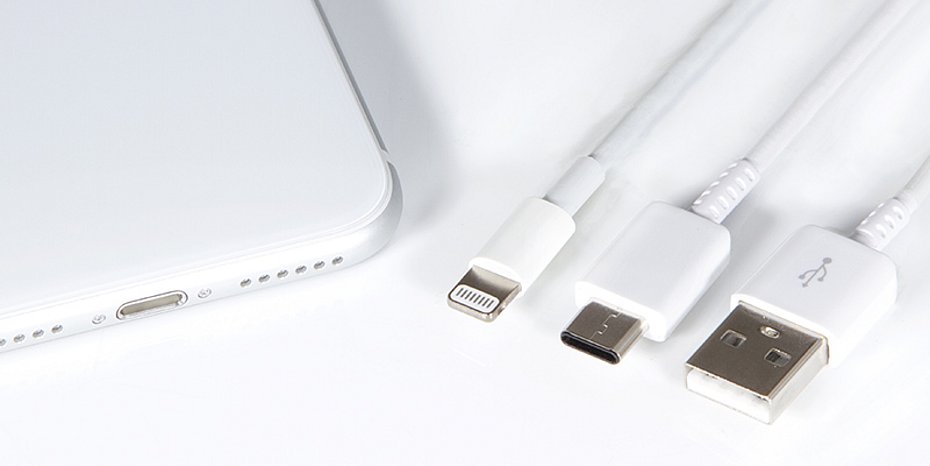
Gold-plated charging contacts & connectors (USB-C, Pogo Pin, etc.) cannot meet the expectations of wearables and cell phones. They corrode during charging if they have previously come into contact with salt water, swimming pool water, sweat or drinks, which leads to numerous complaints and thus expensive replacement of damaged devices. Rhodium is significantly more corrosion resistant than gold and is the precious metal of choice here when the highest quality and safety are required. The corrosion behavior of Rhoduna Alloy coatings is no different from a layer of pure rhodium, as evidenced by sulfide and weld resistance in independent tests conducted by Francéclat. Thus, when contacts are coated with Rhoduna Alloy, they are equally protected against corrosion. The alloy also does not impair the fast-charging capability of the devices.
No reason to use pure rhodium
Also included in the Francéclat test report was Rhoduna PT, a rhodium-platinum alloy. This also achieved excellent wear values compared with pure rhodium coatings and currently offers a cost advantage of over 55 percent due to the precious metal ratio (20 % rhodium, 80 % platinum). Another alternative, considering that the L* value in the test is only just 2 points below that of pure rhodium.
Umicore sees Francéclat's independent test result not only as a confirmation of the product's properties. "The advantages of Rhoduna products for coating technical and decorative surfaces have always been obvious. Now we have independent confirmation that, with Rhoduna Alloy, there is no longer any objective reason to use pure rhodium coatings," says Martin Stegmaier (Division Manager Decorative Applications), pleased with the test result and, above all, "that Rhoduna Alloy is thus the 'white queen' among rhodium coatings and will remain so." (OM-07/23)
Note: Price and savings information as of April 4, 2023.
Sources and further information
Further information on the alternative rhodium coating Rhoduna Alloy and the Francéclat test report:
mds.umicore.com/weisse-koenigin
mds.umicore.com/storage/mds/rhoduna-alloy-test-report-francelat-2022.pdf
www.franceclat.fr
Contact
Umicore Galvanotechnik GmbH
Klarenbergstraße 53 - 79
73525 Schwäbisch Gmünd (Germany)
Phone: +49 (0) 7171 607 - 01
E-mail: galvano@eu.umicore.com
mds.umicore.com
About Umicore Metal Deposition Solutions
Within the Umicore Group, the Metal Deposition Solutions (MDS) business unit is the business headquarters for the two established business units Electroplating and Thin Film Products. Metal Deposition Solutions is one of the world's leading suppliers of products for the (precious) metal-based coating of surfaces in the nanometer and micrometer range - with the expertise of the two divisions, the company combines the two highest-quality processes: Electroplating and PVD coatings.