
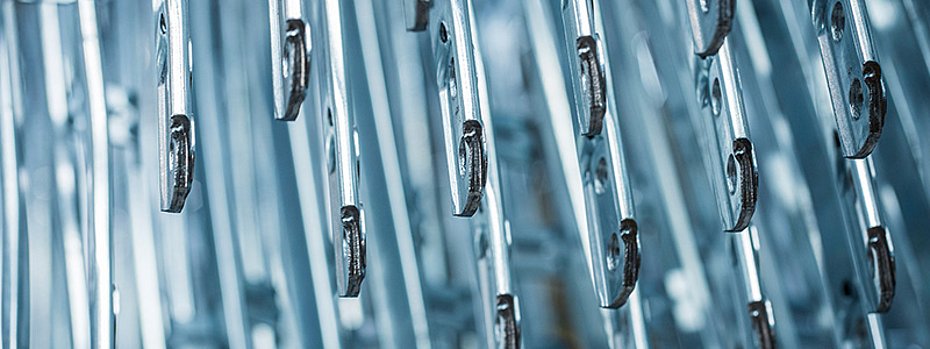
Piece galvanizing offers reliable protection against corrosion and is the most effective technology in surface technology in terms of economy and sustainability. With its new branded surface, the Zinq Group is now achieving new best values here: ecoZinq generates 43 percent fewer CO2 emissions than conventional piece galvanized surfaces that comply with the DIN 1461 standard. This means that ecoZinq currently has the lowest CO2 footprint in the industry - proven and verified by a third party in an environmental product declaration (EPD in accordance with EN 15804). But that's not all: ecoZinq has a demonstrably positive effect on the climate, from which customers also benefit: "We prove the positive impact of our product in the form of carbon credits. To determine the value, we compare the low CO2 emissions of ecoZinq over the entire product life cycle with the highest-quality paint coatings currently available. The positive difference calculated from this is credited to our customers as total CO2 savings," explains Lars Baumgürtel, managing partner of Zinq GmbH & Co. KG. The result is impressive: At +185 kg of CO2 per ton of steel, each ecoZinq customer currently receives the highest CO2 credits in the industry. "This makes the decision to finish steel components with Zinq even more beneficial for the climate," says Baumgürtel.
CO2 emissions reduced through low-carbon Zinq program
The basis for the improvement of the product-related CO2 footprint and the development of ecoZinq is the Low Carbon Zinq program. In this holistically designed program, CO2 emissions have been permanently reduced for many years and for all zinc surfaces of the Zinq Group. For example, more than 10 years ago the company switched its electricity requirements completely to green electricity. In parallel, many individual measures were implemented in the company's own production processes. These include the consistent electrification of the forklift fleet, the widespread use of LED lighting, the use of efficient control technology and heat recovery systems, and optimized process control in the pretreatment and zinc baths. These measures have already greatly improved the climate footprint of the company and its products. Together with zinc suppliers, including an investment in a manufacturer of recycled zinc, a strategy was developed to reduce the carbon footprint of the zinc used. This strategy is being implemented in the ecoZinq product in close cooperation with zinc suppliers through the exclusive use of CO2-reduced primary zinc produced with renewable energies.
High product and proven eco quality
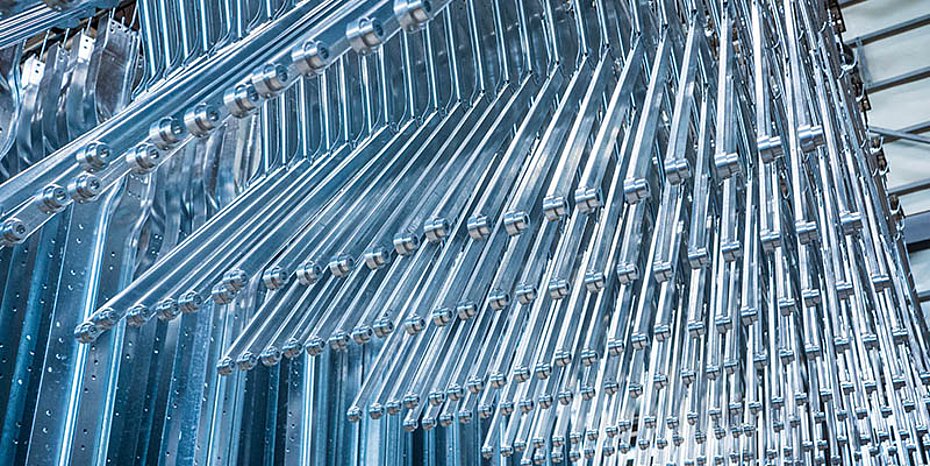
As a result, ecoZinq offers the highest eco-quality without compromising on product quality: the new brand product is Cradle-to-Cradle certified, just like all other Zinq surfaces, and is therefore free of microplastics and other toxic substances that stand in the way of recycling in closed material cycles. ecoZinq also has a third party-validated proof of material health (material health certificate according to C2C-MHC) and is backed by a product circularity data sheet (PCDS according to ISO 59040).
Significant reduction of the product carbon footprint
Low-carbon surfaces like duroZinq already significantly reduce the product-related footprint compared to the industry standard - in Scope 1-3 and over the entire product life cycle, i.e. including use and recycling. The ecoZinq surface significantly surpasses this performance. "Basically, ecoZinq is an eco-upgrade of duroZinq. The product properties are identical, but the environmental performance is once again many times better. This makes ecoZinq an important lever for our steel processing customers to reduce the carbon footprint of their products and another building block on the way to decarbonization and climate neutrality of hot-dip galvanized steel," emphasizes Sven Biebler, Managing Director of Zinq's German plants.
Exact proof of environmental effects through environmental performance evaluation (EPD)
Zinq can provide precise evidence of the concrete impact of its products on the environment and the product-related environmental footprint of its customers: all Zinq surfaces have Environmental Product Declarations (EPD) - drawn up, tested and third-party validated in accordance with Euronorm 15804. In this way, Zinq simultaneously creates a basis for demonstrating the ecological quality of a product, which is becoming increasingly important in a sustainably oriented economy. "A low CO2 footprint of a raw material does not make a product environmentally friendly. It's good to use CO2-reduced zinc, but in the end, all the positive as well as negative environmental impacts of a product, such as a zinc surface, have to be added up - and over the entire life cycle. Then you can optimize the properties through innovations in the direction of fully circular and fully decarbonized. This is exactly what we are doing with the measures we have defined in our PlanetZinq circular business model. As a result, we are pleased to be able to offer cradle-to-cradle products like ecoZinq and contribute to climate-neutral steel products," says Biebler.
ecoZinq achieves highest CO2 credit
For example, the circular-quality Zinq surfaces produced in Germany alone save more than 45,000 t of CO2 per year over their entire life cycle. The savings result, among other things, from the optimized quality of Zinq surfaces in the long usage phase of up to 100 years, as well as from the complete recycling of the metals used. This is because, as a circular company, Zinq thinks of its brands from production to recycling. The ReZinq take-back system closes the material cycle so that zinc can be recycled as often as desired at the end of its useful life without any loss of quality. Ultimately, this is not only good for the environment, but also for Zinq customers' product-related carbon footprint. This is because, thanks to its circular economy, ecoZinq achieves the highest CO2 credits among all ISO 1461 piece galvanized surfaces, at +185 kg CO2 per ton of steel, compared to even the highest-quality paint coatings. "This underlines the importance of zinc as a sustainable material - durable, recyclable and free of microplastics," emphasizes Sven Biebler.
Carbon credits corresponding to the circular quality of the products are credited to Zinq customers on every invoice and reflect the CO2 savings achieved by choosing ecoZinq as a durable surface. The principle is simple: the higher the CO2 savings, the more carbon credits there are. In the medium term, these can be transferred to the digital circular product passports as certificates for balancing circular quality and can already be passed on today. "The European Union is planning to put a CO₂ price on more and more emissions. It is therefore becoming apparent that in the future all environmental impacts will also influence the value of products and thus also help determine the price. Our carbon credits therefore already serve as a basis for reimbursement in the event that a CO2 price is also levied in the future for the calculation of direct and indirect environmental costs over the entire life cycle of the products, converted into CO2 emissions," says Lars Baumgürtel. (OM-6/23)
Contact
Zinq GmbH & Co. KG
Nordring 4
45894 Gelsenkirchen (Germany)
Phone: +49 209 319270-0
E-mail: info@zinq.com
www.zinq.com
About Zinq
Specializing in hot-dip galvanizing and coating for more than 130 years, Zinq is today the market leader in corrosion protection on steel using zinc. Zinq focuses on developing and manufacturing innovative, Cradle to Cradle certified surfaces used in a wide range of steel processing applications.