
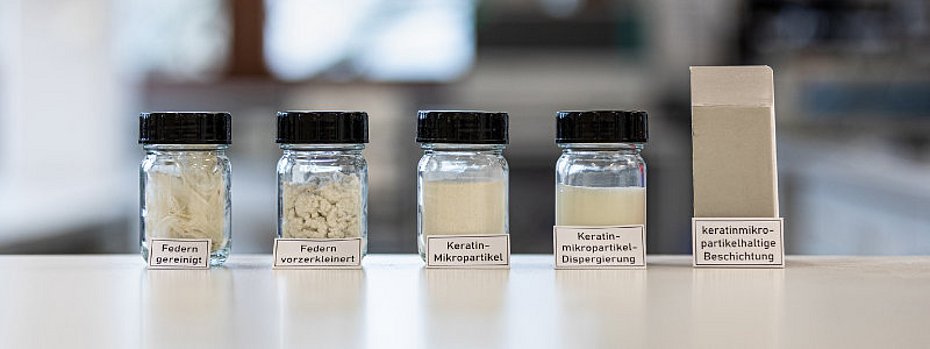
Paints and coatings are often extended with mineral fillers to make them more durable, increase their volume, and reduce manufacturing costs—using silicates and carbonates, for example. These are minerals found in abundance in many types of sand. However, to use them as fillers, the sand must first be filtered, purified, and then chemically transformed using a significant amount of energy—a major cost factor these days.
Researchers at the Fraunhofer Institute for Applied Polymer Research IAP in the Potsdam Science Park and at the Fraunhofer Institute for Manufacturing Engineering and Automation IPA in Stuttgart have therefore set out to find cost-effective alternatives. They came across a biogenic waste product that is produced in enormous quantities worldwide but has hardly been put to use so far: chicken feathers.
Keratin from Chicken Feathers as a Structural Protein for Coatings
“Chicken feathers aren’t suitable for comforters or down jackets, and only a very small amount is processed into meal and fed to livestock,” says Dmitry Grigoriev of Fraunhofer IAP. “The vast majority rots away in landfills or is incinerated. Yet feathers contain keratin, a robust structural protein with interesting properties,” the chemist continues.
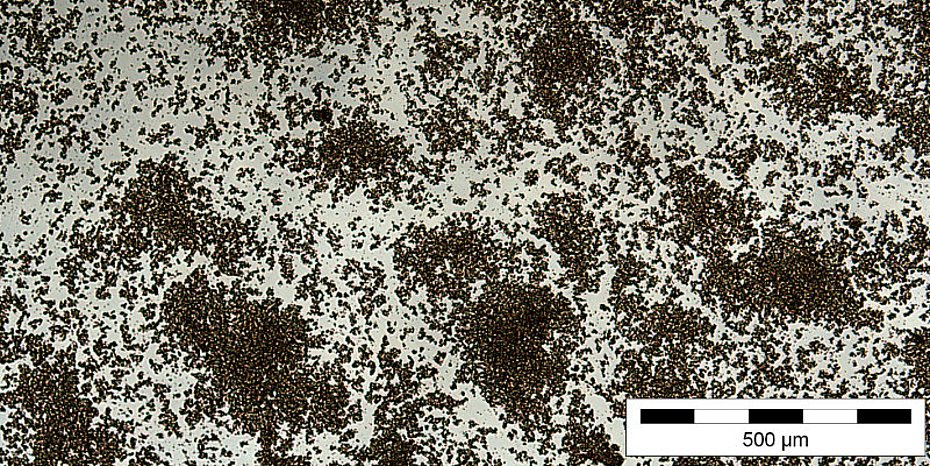
When keratin ground into a microfine powder is mixed with water and sufficiently dispersed, a milky liquid forms that can be broken down only very slowly by microorganisms. This means that keratin not only has the potential to be a cost-effective filler but could also serve as a base material for paints and coatings with increased resistance to microbial attack. In laboratory tests, keratin combined with small amounts of copper salts or particles also demonstrated a protective effect against ultraviolet radiation. This means that keratin particles could in the future perform functions similar to those of titanium oxide. Titanium oxide also has antibacterial properties and protects against UV light, but is considered a possible carcinogen.
Boron nitride can also interact with keratin. When particles of both substances are present in a binder, ordered structures can form. This makes the coatings mechanically stable and impact-resistant. “It takes a very long time for water to penetrate these layers. This suppresses its swelling and corrosive effects,” says Matthias Wanner of the Coating Chemistry and Application Technology research team at Fraunhofer IPA. “This would make it possible to develop keratin-containing coatings that protect against rust—for example, powder coatings for fences, garden tools, or outdoor furniture,” adds Grigoriev. To move closer to this goal, the two researchers plan to collaborate in the future withEnviral®, a surface finishing company based in Niemegk, Brandenburg, that specializes in the application of powder coatings.
Industrial Production Project
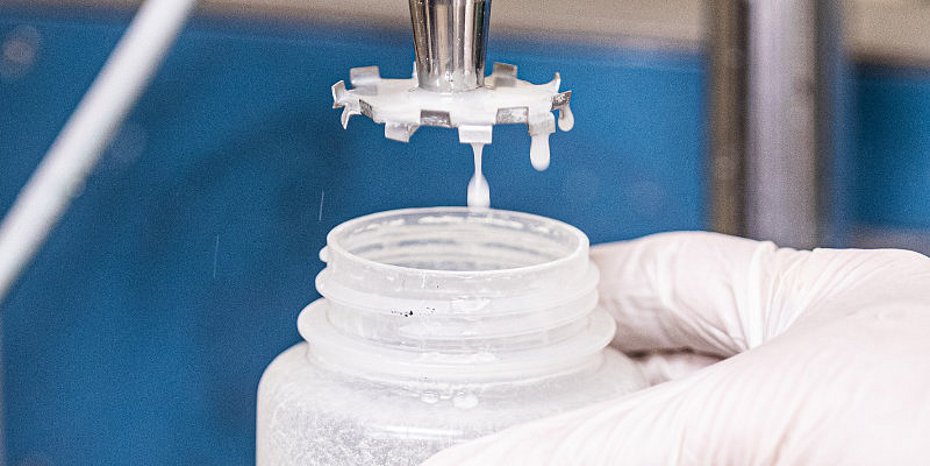
In order to use keratin in multifunctional additives for coatings, the chicken feathers must be cleaned and ground into a fine powder. In their laboratory experiments, Grigoriev and Wanner tested various methods. While chemical processes make it relatively easy to produce large quantities of keratin powder, the keratin loses some of its functionality in the process.
Mechanical or mechanochemical production methods yield better results, but they have drawbacks in other areas: In the lab, the researchers were only able to produce a few grams of powder. To make mechanical production viable on an industrial scale, Grigoriev and Wanner plan to collaborate with Zoz GmbH in the future. The company, based in Wenden in the Sauerland region, develops and manufactures specialized equipment for mechanical process engineering and uses its own facilities to produce nanostructured high-performance materials.
The project partners’ goal is to reduce waste volumes and costs. Since transporting feathers is uneconomical due to their large volume, a specially developed cleaning and grinding system is intended to address this issue. In this plant, the chicken feathers are cleaned on-site and ground into nanopowder, which is then recycled or further processed. This results in cost- and resource-efficient disposal, a reduction inCO2 emissions from logistics, and lower production costs for paints and coatings. (OM-6/26)
Contact
Fraunhofer Institute for Manufacturing Engineering and Automation IPA
Nobelstraße 12
70569 Stuttgart (Germany)
www.ipa.fraunhofer.de
About the Fraunhofer Institute for Manufacturing Engineering and Automation (IPA)
The Fraunhofer IPA was founded in 1959 and employs approximately 1,200 people. Its research and development efforts focus on organizational and technological challenges in manufacturing. Methods, components, and equipment—all the way up to complete machines and systems—are developed, tested, and implemented as pilot projects. Fraunhofer IPA’s 19 departments cover the entire field of production engineering and collaborate on an interdisciplinary basis with industrial companies in the automotive, mechanical and plant engineering, electronics and microsystems, energy, medical and biotechnology, and process industries.