
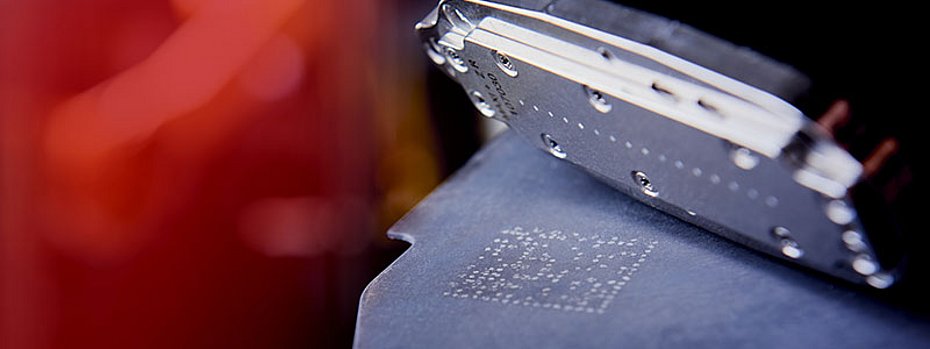
Dresden-based start-up Senodis Technologies GmbH presents an innovative solution for individual component marking in high-temperature processes in metalworking: CeraCode. The marking by a data matrix code is done with a specially developed ink that withstands temperatures of 1,300 degrees, as can occur in hot forming, press hardening or case hardening. Until now, no satisfactory marking solution existed that could safely withstand the downstream high-temperature processes on the one hand and enable individual traceability on the other. With CeraCode, components can now be individually identified and all relevant data can be linked to the component and read out throughout the entire process.
Data matrix code with temperature-stable ink
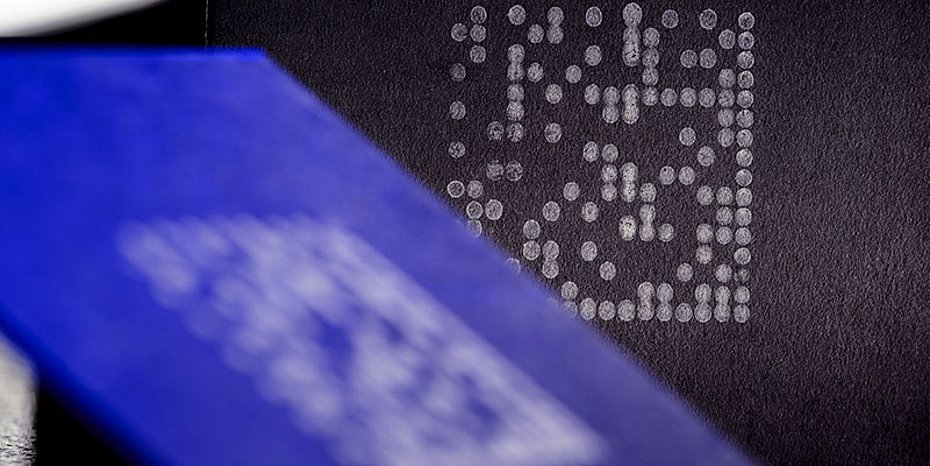
CeraCode is printed onto the component as a data matrix code using a high-temperature-stable ink before the temperature processes. The ink was developed by Senodis on the basis of ceramic pigments that form a material bond with the component surface - whether steel, ceramic or even glass - when exposed to temperature. Depending on its composition, it can easily withstand temperatures of over 1,300 degrees Celsius. All process data relevant to the component (production day and number, furnace temperatures, throughput times, pressures, forming degrees and thicknesses) can be assigned to the code and read out at further process stations.
Reduce sorting costs, cycle time under two seconds
Frequently, for example, press hardening is carried out with impact stamps which, however, only imprint weekly numbers, which accordingly do not allow individual assignment. In the case of defective parts, entire batches must then be inspected, which results in high sorting costs. The metal can also be affected by the impact stamp. Another option is laser marking, which allows an individual identification number, but significantly increases cycle times overall and means a greater investment in terms of acquisition and safety measures. Marking with CeraCode takes into account the tight cycle times of the processes; it is carried out in less than two seconds or completely inline and can therefore be integrated very well in terms of time.
Key to digitization
Process data is already generated at many points in production processes. With CeraCode, they can now be individually linked to a component and merged in a database. This enables end-to-end digitization and transparent traceability. Rejects can be significantly reduced and processes optimized thanks to the database.
Customized total solution comprising ink portfolio, printer, image capture and IT integration
Senodis provides a complete solution that was tested in a pilot project with a major German car manufacturer. The basic version includes the marking, the initial recording in front of the oven as well as the second recording stage, i.e. the readout via industrial scanner behind the oven. Dr. Christoph Kroh, co-founder and managing director at Senodis, emphasizes that CeraCode is not a "one-fits-all solution" that can be imposed on any production process, but that the company always customizes the system, from inks for specific surface finishes to providing a database solution for managing process data - as needed. (OM-09/23)
Contact
Senodis Technologies GmbH
Manfred-von-Ardenne-Ring 20 D
01099 Dresden (Germany)
Phone: +49-351-896960-10
Email: info@senodis.io
www.senodis.io
About Senodis
Senodis Technologies GmbH was spun off from the Dresden-based Fraunhofer Institute for Ceramic Technologies and Systems (IKTS) in 2019. The technology start-up has developed a new marking process - CeraCode - that ensures seamless component marking even at very high process temperatures in metal processing.