
Where metal components are subjected to high temperatures and forming processes, it is difficult to permanently apply markings for subsequent component identification and traceability. The Dresden-based technology start-up Senodis has now expanded its product portfolio to include the CeraCode Flex marking solution for components in massive forming.
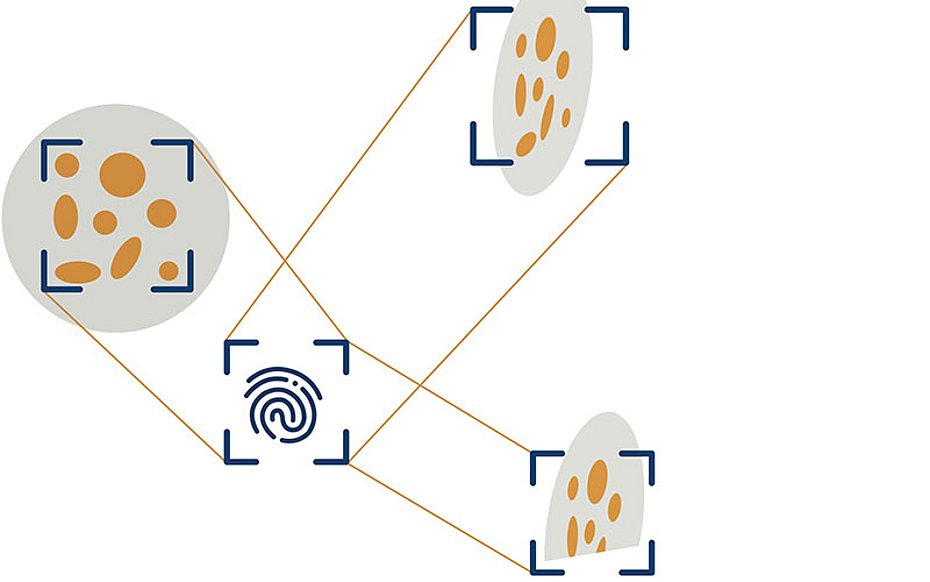
At the heart of the previous CeraCode marking process (now CeraCode Base) is the specially developed heat-stable ink portfolio, which can withstand temperatures of up to 1,600 degrees Celsius. These inks are also used in the new process. However, as standard 2D codes, such as the data matrix code used in CeraCode Base, can no longer be read later due to the deformation, a free, randomly arranged marking is applied here, the unique features of which are used to generate an individual ID.
Free-form marking for traceability in solid forming
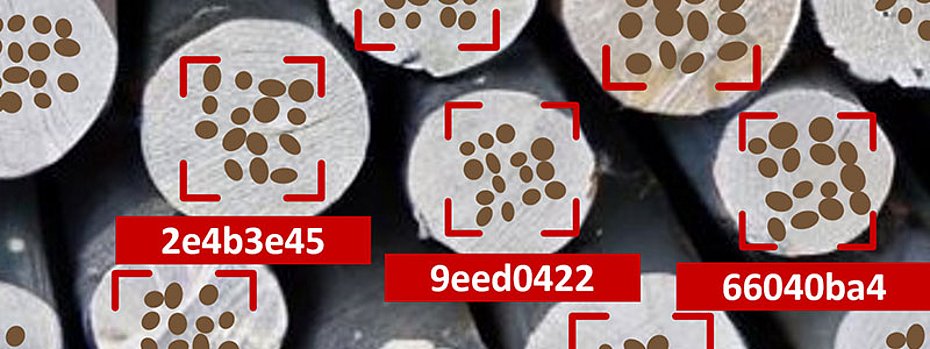
This free-forming process is particularly useful in massive forming, for example for bar steel. When the steels come out of continuous casting at around 900 degrees Celsius, they are still traceable. The steels are then cooled down to around 300 degrees Celsius and cut to size. At this point in the separation process, the information on the material flow breaks down very quickly, meaning that marking is desirable here, but cannot be achieved with standard printers due to the temperature. With the help of heat-stable inks, clearly identifiable patterns can be applied to the front of the bars even at a surface temperature of 300 degrees Celsius, either by means of a shot marking from a certain distance or using a transfer printing process.
Descriptor ID process also identifies deformed markings
The completely free character of the marking also makes it possible to apply it to a component before a forming step, to evaluate it before and after forming and to clearly assign it to the component again using a before/after link. CeraCode Flex is therefore more than just a printing process; the integrated descriptor ID process itself can also be relevant for other applications, for example for protecting products against counterfeiting. Even the smallest deviation in the print image provides a clear assignment to a specific component. The CeraCode Flex marking solution is currently being tested in pilot projects with customers from the metal industry. (OM-1/24)
Application example: steel bars
Process information can be lost during customer cutting and the associated logistics. During separation, a free, randomly arranged marking can now be applied using free-form marking. An individual ID is generated from their unique characteristics, which ensures the further traceability of the respective component.
Contact
Senodis Technologies GmbH
Manfred-von-Ardenne-Ring 20 D
01099 Dresden (Germany)
Phone: +49-351-896960-10
Email: info@senodis.io
www.senodis.io
About Senodis
Senodis Technologies GmbH was spun off from the Dresden-based Fraunhofer Institute for Ceramic Technologies and Systems (IKTS) in 2019. The technology start-up has developed a new marking process - CeraCode - that ensures seamless component marking even at very high process temperatures in metal processing.