

Whether on public transportation, in the operating room, in building systems, or in production environments, contact surfaces are among the most frequently used interfaces in everyday life. At the same time, they can transmit viruses for hours or even days. Existing infection control strategies rely primarily on cleaning and disinfection, which, however, are only effective to a limited extent and require a corresponding investment of resources. The Fem Research Institute, in collaboration with the Dechema Research Institute, has developed a surface concept in which antiviral properties are directly integrated into anodized aluminum surfaces. This provides industry and infrastructure with an approach for robust, low-maintenance hygiene solutions in high-wear applications.
Antiviral function firmly anchored in the anodized layer
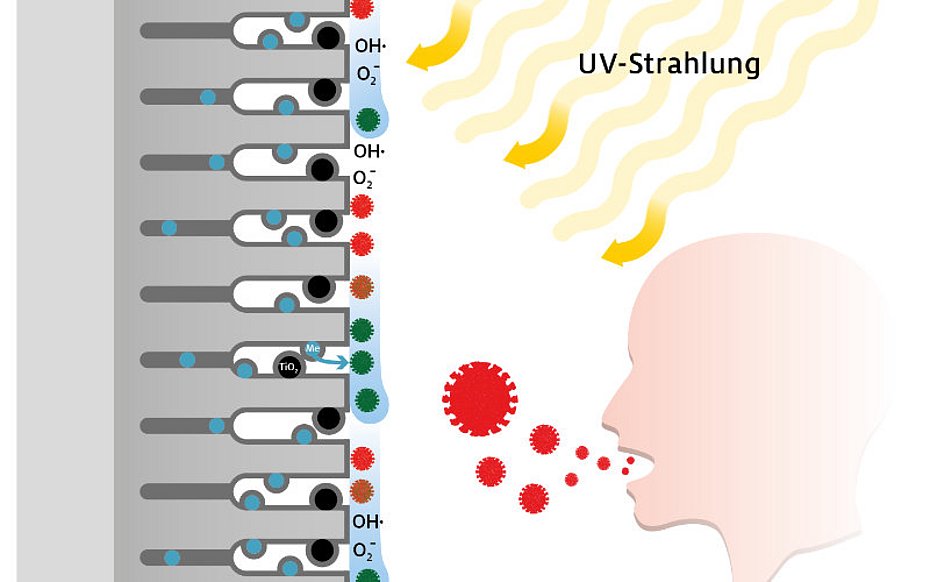
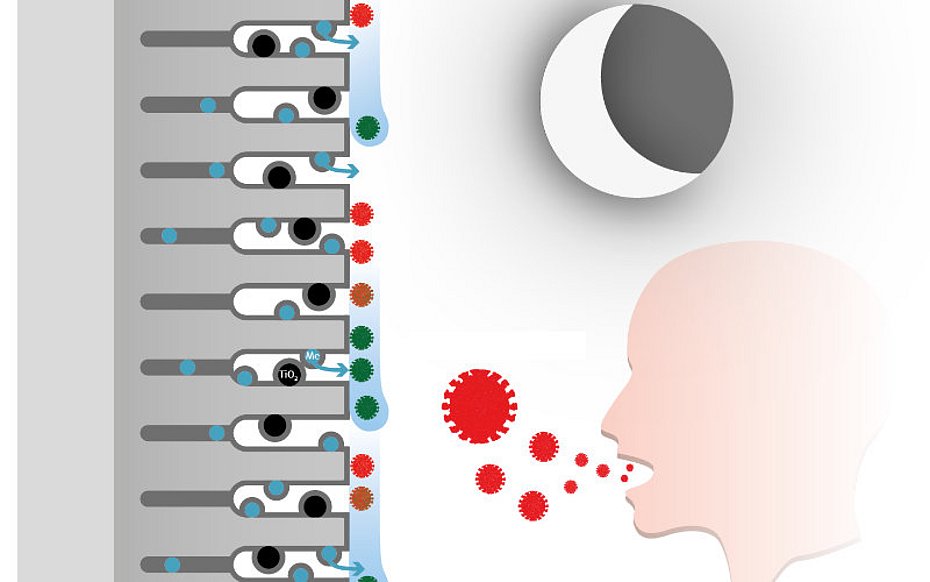
The function is not applied as a separate coating, but is integrated into the anodically produced oxide layer of aluminum. Its microscopically fine pore structure serves as a reservoir for antiviral particles based on copper or silver, among other materials. These particles are introduced into the pores and bound to the surface. The basis for this is a targeted layer design: A dense base layer ensures corrosion protection and mechanical stability, while an open-pored functional layer, which lies on top of the base layer, carries the active components. This creates a surface in which the antiviral property is permanently anchored within the material and remains intact even under abrasion, cleaning, and continuous use.
“The key difference from traditional coating solutions is that the antiviral function is not merely applied to the surface but is integrated into the anodized layer. This ensures that it remains permanently effective even under mechanical stress, without compromising the material’s established properties,” says Dr. Christof Langer, head of the Light Metal Surface Technology Department at the Fem Research Institute.
Integration into existing process chains
The process can be integrated into existing anodizing facilities. While adjustments to individual process steps are required, a completely new production line is not necessary. This facilitates the transition to industrial application and significantly reduces the investment required by companies. At the same time, the economic risk associated with introducing the technology is reduced. Coating companies, suppliers, and component manufacturers can thus enhance their products with an additional function. Following successful scaling, the process also offers potential for use in industrial mass production.
The technology is particularly relevant for components that are frequently used and touched. These include, for example, handrails and door handles in public transportation, control elements in mechanical and plant engineering, fixtures in buildings, and components in medical facilities. Wherever surfaces are touched regularly, functionalized anodized coatings can help ensure that hygiene requirements are met on a long-term basis.
New Market Opportunities for Functional Coatings
Operators in the infrastructure and building management sectors benefit in two ways: On the one hand, the antiviral function enhances safety during ongoing operations; on the other hand, it reduces cleaning and maintenance efforts.
Anodized coatings are evolving from purely decorative protective systems into carriers of additional functions. As a result, they increasingly offer technical and economic advantages that set them apart. “For the industry, this creates additional value-added potential along the entire process chain—from material development through coating to integration into end products. At the same time, the requirements for quality assurance and reliable verification of functionality are increasing,” emphasizes Langer. (OM-7/26)
About the Research Project on Antiviral Anodized Surfaces
The research project on the development of antiviral anodized surfaces was conducted as part of IGF Research Project 22658 N and funded by the Federal Ministry for Economic Affairs and Energy pursuant to a resolution of the German Bundestag. The Fem Research Institute developed the anodized coating concept and integrated self-synthesized silver and copper particles, as well as titanium dioxide particles, into the anodic oxide layers. The titanium dioxide particles were produced by the Dechema Research Institute, which also developed the testing methodology and investigated the antiviral properties of the functionalized surfaces.
Contact
Fem Research Institute
Katharinenstraße 13–17
73525 Schwäbisch Gmünd (Germany)
Phone: +49 7171 1006-0
Email: info@fem-online.de
www.fem-online.de
About the Fem Research Institute
Since 1922, the Fem Research Institute in Schwäbisch Gmünd has been one of the leading institutes for the research, development, and analysis of metallic materials and coatings. It is also the world’s only independent precious metals institute. The goal of the approximately 100 employees working in the fields of materials science, metal chemistry, and surface technology is to develop customized and forward-looking solutions for industry as well as small and medium-sized enterprises.