
Dürr: Dry coating of electrodes developed
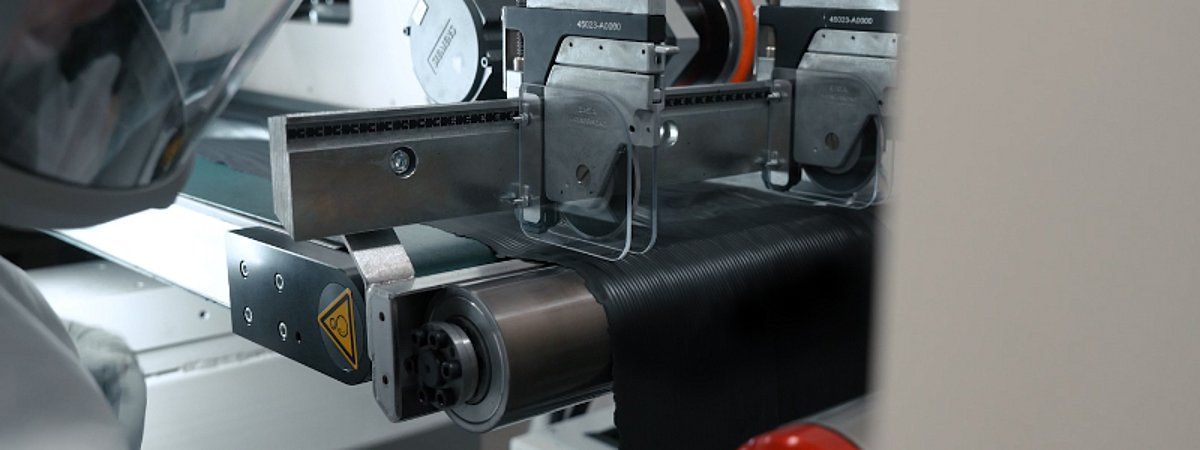
With X.Cellify DC, Dürr has developed a new type of dry coating for electrodes: The result is a free-standing film of active material that can be 100 percent recycled back into the process until it is laminated onto the collector foil.
Until now, electrode production has almost exclusively used wet coating, in which the cathode and anode material is applied as a solution to metal foils and then dried in an energy-intensive process. The technology developed by Dürr together with partners does not require solvents or drying ovens, as it produces the electrodes from a dry powder mixture. The dry battery material is pressed into a film using the Activated Dry Electrode process from development partner LiCAP Technologies. The new development X.Cellify DC maps all process steps - from dosing, film formation and compaction to lamination onto the collector foil.
Electrode production with dry coating instead of wet coating
Compared to conventional wet coating, dry coating offers clear advantages in electrode production: it reduces the space required by up to 65 percent and cuts energy consumption by up to 70 percent. These savings are mainly due to the elimination of dryers and solvent recovery. "The successful proof of concept is a big step forward for us. We have shown that the new type of dry coating with free-standing film works reliably and delivers consistently good quality. It can be scaled up and is therefore the basis for the first pilot projects in industry," explains Bernhard Bruhn, Vice President of Dürr's Global Business Unit LIB. The process is suitable for today's lithium-ion batteries as well as for solid-state batteries.
Free-standing film for electrodes reduces waste
The proof-of-concept system is located in Chassieu in the south of France in a dry room environment of Ingecal, a subsidiary of the Dürr Group specializing in calendering technology. Calenders are machines with rollers that compress materials into an even layer. Dry coating starts with film formation: a horizontal calender forms the dry powder into a film. It is referred to as "free-standing" as it runs through the system without a carrier film. In the second step, further calenders compress the film to the desired layer thickness, density and porosity. Finally, one film from each side is laminated onto the collector foil - and the electrode is produced. "As we manage without a carrier film until the last step, we can return the film to the process in its entirety if it does not meet the desired specifications. The closed loop means that no more valuable active material is lost and we significantly reduce waste - an important point in battery production," explains Bruhn. The special feature of X.Cellify DC lies in the web guidance: the system transports the free-standing film in a self-supporting manner and compacts the film before it is applied to the collector foil. Less force is required for the subsequent lamination onto the collector foil than for calendering in the wet coating process, so there is no deformation of the foil, which improves processability for the downstream notching and stacking process steps. Dürr is also looking for pilot partners from industry for projects.
Contact details and information on the companies and institutions presented here can be found in our interactive surface technology industry directory.