
Hydrogen damages steels. High-strength steels in particular, such as those used in the construction of bridges, high-rise buildings and oil and gas infrastructure, are susceptible to embrittlement caused by atomic hydrogen from the environment. The complex mechanisms behind this are not yet fully understood. Native oxide layers on steel can act as barriers that prevent hydrogen from penetrating the workpiece. Empa researchers want to investigate how hydrogen interacts with the thin oxide layers, with high spatial and temporal resolution.

Hydrogen embrittlement causes bridge collapse
On the night of 11 September 2024, an approximately 100-metre-long section of the Carola Bridge in Dresden collapsed into the Elbe. The cause: cracks in the bridge's steel tension structure. The culprit: hydrogen. The Carola Bridge is by no means the first structure to be affected by hydrogen. Other well-known examples include the London skyscraper "122 Leadenhall Street", popularly known as the "Cheesegrater", and the partial reconstruction of the Bay Bridge in San Francisco, where the failure of the steel bolts resulted in millions of euros in renovation costs. The process is called hydrogen embrittlement. Certain corrosion processes in the presence of water release atomic hydrogen - the smallest element in the periodic table - on the surface of steel components. Thanks to its small size, the hydrogen diffuses into the steel, where it promotes the formation of cracks through various mechanisms.
The fact that hydrogen attacks metals has been known since the 19th century. However, the complex mechanisms behind hydrogen embrittlement are still not fully understood - despite numerous studies. Empa researchers from the Joining Technology and Corrosion Laboratory are now investigating a side of hydrogen embrittlement that has received very little attention to date: the interaction of hydrogen with the so-called native oxide layer on steel. The native oxide layer, also known as the passivation layer, is a thin layer that forms naturally on the surface of most metals and alloys. It gives stainless steels their corrosion resistance. The type and composition of the layer, which is only a few nanometers thick, differs from steel to steel. Certain oxides are significantly more stable and resistant to hydrogen than others. They protect the steel better against embrittlement. This is what Empa researchers Chiara Menegus and Claudia Cancellieri want to investigate. They are paying particular attention to the interface between the metal and its oxide layer. "Hydrogen accumulates in the material where there is disorder," explains doctoral student Menegus. "The interface between the metal and the oxide is one such place."
Innovative test setup
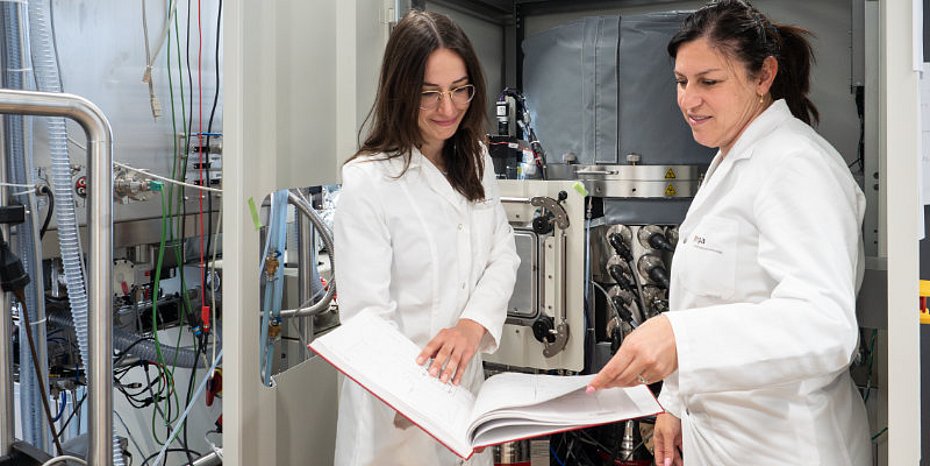
Research into hydrogen in steel is challenging. The light element cannot be determined using conventional analytical methods. The experiments must also take place in the absence of all other environmental factors such as oxygen and moisture - otherwise complex interactions and corrosion processes arise that mask the influence of hydrogen. The final major challenge is the interface itself: "It is difficult to investigate a hidden interface inside the material without destroying the sample," says Claudia Cancellieri, research group leader in the Joining Technology and Corrosion Laboratory.
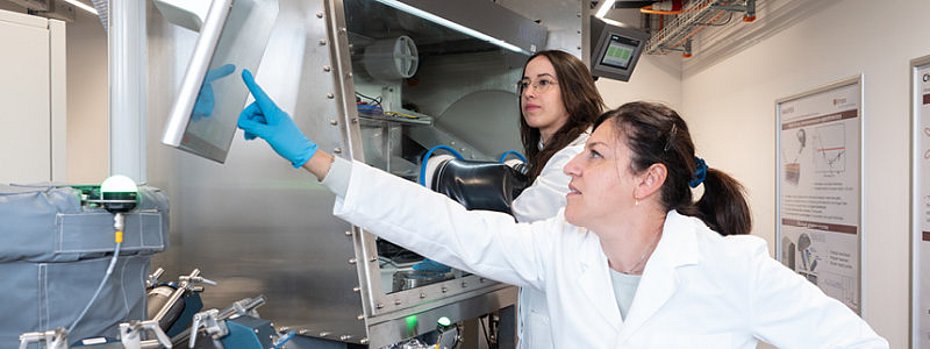
The researchers mastered these challenges with an innovative experimental setup. In the first year of her doctorate, Chiara Menegus developed an electrochemical cell in which the steel sample is fixed. On one side of the sample is water, on the other the inert noble gas argon. By applying an electrical voltage, atomic hydrogen is generated from the water. It diffuses through the thin sample until it reaches the oxide layer on the opposite side, where it interacts with the native oxide. "This allows us to isolate the interaction of atomic hydrogen with the native oxide from other environmental influences," explains Menegus. All steps - from assembling the cell to analyzing the sample - take place in a protective atmosphere, in a glovebox.
Hydrogen breaks down the protective oxide layer
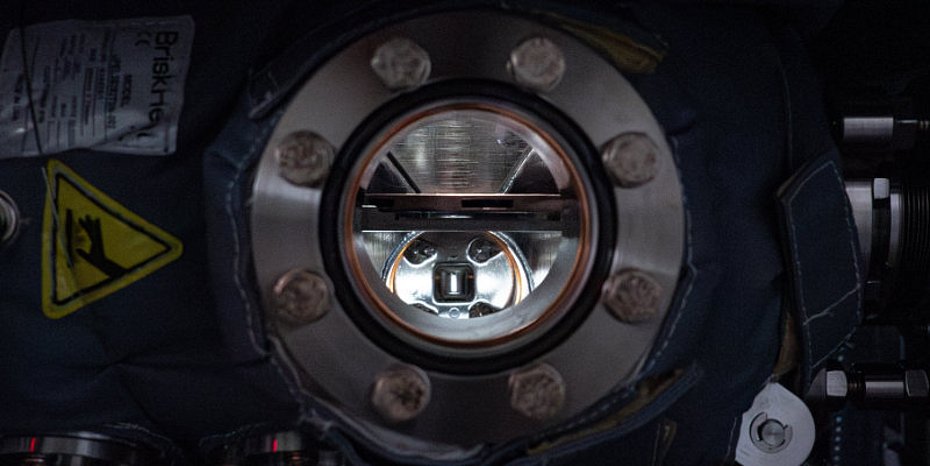
To characterize the samples, the researchers use an analysis technique that is unique in Switzerland: hard X-ray photoelectron spectroscopy (HAXPES for short - see info box). This spectroscopy method uses high-energy X-rays to determine the type and chemical state of atoms in a material, not just on the surface, but up to 20 nanometers deep - enough to detect the oxide layer, which is around five nanometers thick, and the interface with the steel underneath.
Although the hydrogen itself cannot be detected directly, the researchers have already been able to clearly demonstrate its effects on the entire oxide layer. "The first tests show that the hydrogen breaks down the protective oxide layer," says Menegus. She now wants to investigate the oxides on different iron-chromium alloys as well as on some common steels. The researchers will then work together with the "Ion Beam Physics Lab" at ETH Zurich to determine the hydrogen content in the samples directly - in real time, using a complex particle accelerator method. "We hope this will help us to better understand the effect of hydrogen on the native oxide layers and to find particularly resistant oxide forms," summarize Menegus and Cancellieri. Their findings could lead to the construction of more durable bridges - as well as to better infrastructure for the storage and transportation of green hydrogen. (OM-2/26)
HAXPES
HAXPES stands for "Hard X-ray Photoelectron Spectroscopy". This analysis method is based on the photoelectric effect, for the discovery of which Albert Einstein was awarded the Nobel Prize in Physics in 1921. Electrons are "knocked out" of the material using X-rays, allowing conclusions to be drawn about the chemical composition of the sample. While conventional X-ray photoelectron spectroscopy is limited to the surface of the material, the "hard" version - HAXPES - penetrates much deeper into the material thanks to high-energy radiation and allows precise characterization of multi-layered structures and internal interfaces. HAXPES has applications in the development of microelectronic components, solid-state batteries and functional thin films as well as in catalysis and corrosion research. The only facility in Switzerland is located in the Laboratory for Joining Technology and Corrosion at Empa.
Contact
Empa
Überlandstrasse 129
8600 Dübendorf (Switzerland)
Phone +41 58 765 11 11
www.empa.ch/
About Empa
The Swiss Federal Laboratories for Materials Science and Technology (Empa) is the ETH Domain's interdisciplinary research institute for materials science and technology. As a bridge between research and practical application, it develops solutions for the primary challenges facing industry and creates the scientific basis for the sustainable development of our society.