
Wisag Group offers paint stripping as a service
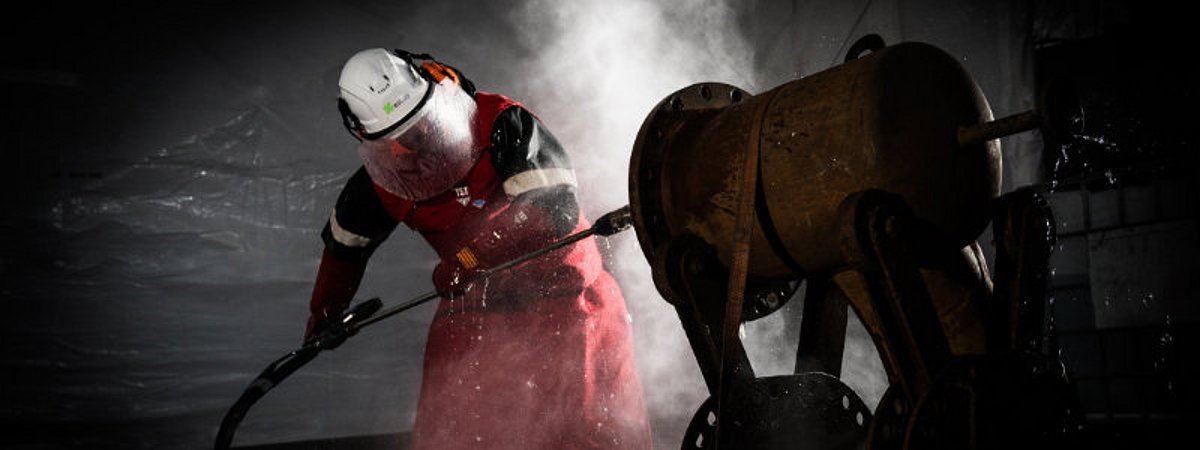
As an industrial service provider, the Wisag Industrie Service Group offers various processes for the paint stripping of surfaces. Customers are supported with various paint stripping methods such as chemical processes, dry ice cleaning or thermal paint stripping.
Downtime, loss of quality or damage to components can often be traced back to unsuitable paint stripping. This makes it all the more important to choose a process that is precisely tailored to the material, component geometry and coating. The Wisag Industrie Service Group, one of Germany's leading industrial service providers, supports its customers with various paint stripping methods and identifies the most technically and economically viable solution for every application. In addition to chemical processes and dry ice cleaning, Wisag's service portfolio primarily includes thermal paint stripping using pyrolysis, ultra-high pressure water cleaning and laser cleaning. "None of the processes are the main focus for us," says Fabian Härtel, Head of Technology at Wisag Produktionsservice GmbH. "We want to give our customers the best possible advice and therefore first take a close look at the individual circumstances and requirements."
Various processes for paint stripping
Pyrolysis, for example, is based on the thermal decomposition of organic coatings in the absence of oxygen and is particularly suitable for robust metallic components with complex geometries or thick layers of paint. The workpieces to be processed are heated in a closed oven system in a controlled manner so that the coatings are completely removed without affecting the base material. The industrial service provider also uses ultra-high-pressure water cleaning, in which layers of paint are mechanically removed from the substrate using a highly concentrated jet of water. This process is primarily used for resistant components with a simple geometry and enables effective paint stripping without chemical additives or thermal stress. For selective applications and sensitive surfaces, Wisag has another option in the form of laser cleaning. The non-contact technology allows precise removal of coatings, generates no blasting agent waste and requires only a small amount of input material. This can prove to be a particularly suitable alternative for flat surfaces or selective tasks. "In our experience, there is no one paint stripping process for all cases," explains Härtel. "The decisive factor is the correct classification of the component and the process requirements. This is precisely where we see our role as a system partner to the industry."
Contact details and information on the companies and institutions presented here can be found in our interactive surface technology industry directory.