
Thin platinum layers reduce platinum consumption in hydrogen electrolysis
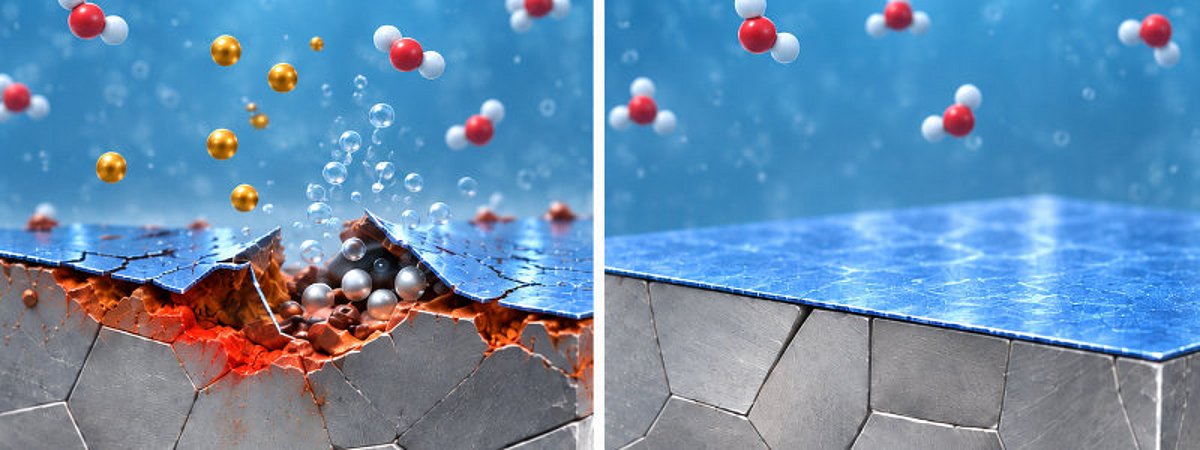
PEM water electrolysis requires corrosion-resistant components, some of which are coated with expensive platinum. Researchers at TU Wien have now shown that platinum consumption can be reduced by up to 88 percent by using thinner protective coatings.
PEM water electrolysis requires corrosion-resistant components, some of which are coated with expensive platinum. Researchers at TU Wien have now shown that platinum consumption can be reduced by up to 88 percent by using thinner protective coatings. Hydrogen is poised to become an energy carrier of the future, particularly for industrial applications. This requires climate-friendly technologies that split water into hydrogen and oxygen. A major challenge here is cost: PEM water electrolysis requires components that are particularly corrosion-resistant. Bipolar plates play a key role in this process, accounting for up to 30 percent of the system’s total cost. Titanium is a suitable material, as it is highly corrosion-resistant even under aggressive conditions. However, an oxide layer forms on the titanium surface, which impedes the flow of current. For this reason, such bipolar plates are coated with a thin layer of platinum.
A 24-nanometer-thin platinum layer protects titanium from corrosion
Experiments at TU Wien now show that a platinum layer just 24 nanometers thick is sufficient under the conditions studied. In contrast, significant problems arose with a layer thickness of eight nanometers. Compared to a 200-nanometer-thick coating, as currently used in industry, this approach would save approximately 88 percent of the platinum. To investigate the coatings’ durability, the researchers analyzed the layers before and after electrochemical stress using high-resolution methods. In the 8-nanometer-thick platinum layer, they found clear evidence of damage. The 24-nanometer-thick layer, on the other hand, remained largely intact and retained its good electrical conductivity. The release of metal ions was also limited to a very low level. The optimal layer thickness depends, among other factors, on the manufacturing technique and the uniformity of the coating.
Contact details and information on the companies and institutions presented here can be found in our interactive surface technology industry directory.