
New paint from Nissan lowers temperature on vehicle surface
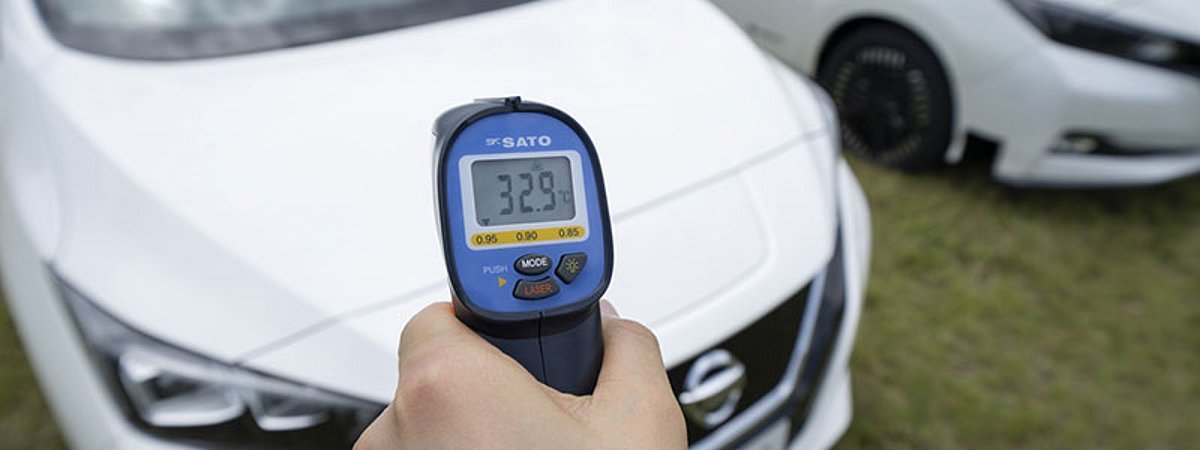
Nissan is testing a new paint technology that is designed to reduce the temperature on the vehicle surface and thus also in the interior on hot days. This also puts less strain on the air conditioning system, which can save energy.
Nissan's new paint to reduce the temperature on vehicle surfaces has been developed in collaboration with Radi-Cool, a specialist in radiant cooling. The paint is made from synthetic composites with structures not normally found in nature. The project is one of Nissan's many innovations on the road to a cleaner and more sustainable society. The paint has been tested since the end of 2023 in a 12-month feasibility study at Tokyo Haneda Airport, which Nissan is conducting in collaboration with Japan Airport Terminal Co, Ltd, Radi-Cool Japan and All Nippon Airways (ANA) Airport Services. The paint was applied to a Nissan NV100, which is used as an airport service vehicle. With its large, open tarmac, Haneda Airport provides the ideal environment to test the paint's performance in a demanding, high-temperature environment under real-world conditions.
New vehicle paint significantly reduces temperature compared to conventional paint
Although the end of the test phase has not yet been reached, the results so far are impressive: compared to a vehicle with a conventional paint finish, the vehicle with the new paint showed an exterior temperature that was up to twelve degrees Celsius lower and an interior temperature that was up to five degrees Celsius lower when parked in direct sunlight. The cooling effect of the paint is particularly noticeable when a vehicle is parked in the sun for long periods of time. The cooler interior means that the air conditioning system works more efficiently, which in turn reduces the load on the engine or, in the case of electric cars, on the battery. The nanomaterial embedded in the paint consists of two microstructure particles that react to light. One of the particles reflects the infrared rays of sunlight, which cause vibrations at molecular level in conventional paints and thus generate heat. The other particle is the real technological breakthrough. It generates electromagnetic waves that counteract the sun's rays and dissipate the heat energy away from the vehicle into the environment. Thanks to this combination, the particles in the paint reduce heat transfer to surfaces such as the vehicle roof, hood, doors and trim.
Further development of radiant cooling paint technology
The technology of radiant cooling paint is not entirely new, but is generally used more for buildings and structures. The paint layer here is often very thick and must be applied with a paint roller. As it does not contain a clear top coat, chalk-like residues can remain when touched. The biggest challenge was therefore to develop a paint that contains a clear top coat, can be applied with a paint gun and also meets the strict Nissan standards for paint quality. Since the start of development in 2021, more than 100 material samples have been tested and are currently testing a coating thickness of 120 micrometers, which is approximately six times thicker than a conventional car paint. The tests show that the paint is resistant to salt and breakage, does not peel off, does not scratch and does not react chemically, and that the color is consistent and repairable. In the further course of development, thinner variants were researched that offer the same cooling performance. Great potential for the new paint technology is seen particularly in the area of light commercial vehicles such as vans, trucks and ambulances, which are in use for a large part of the day.
Contact details and information on the companies and institutions presented here can be found in our interactive surface technology industry directory.