
Member of the German Bundestag Uwe Schmidt visits Seppeler Feuerverzinkung
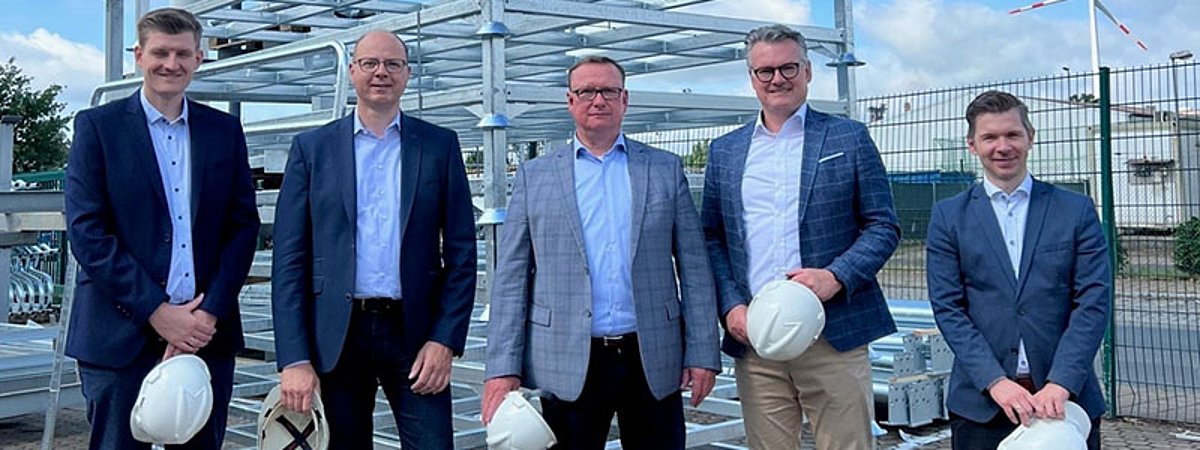
Uwe Schmidt, member of the German Bundestag for the SPD parliamentary group, recently visited Seppeler Feuerverzinkung in Bremen. He exchanged views with Seppeler management on various topics, including transformation prospects and qualification.
During his talks, Uwe Schmidt, member of the Bundestag, visited the Seppeler hot-dip galvanizing plant and exchanged views with the managing directors, Stefan Neese and Thomas Weise, the business unit manager, Pascal Monkenbusch, and the general manager of the Industrieverband Feuerverzinken e.V., Sebastian Schiweck, on various topics. As part of the Seppeler management, Thomas Weise would like to see a clear and unambiguous transformation perspective and a closing of ranks between the hot-dip galvanizing industry and politicians. A transformation electricity price for industries that can and want to electrify would be a solution in Weise's view. Moreover, action should be taken with caution and foresight. "As a medium-sized and family-run company, we are of course moving with the times and trying to reduce our CO2 emissions as best we can at all levels. However, we do not see any transformation prospects for hot-dip galvanizers, because tax breaks or support programs are mostly granted to large companies by politicians. We would like to see a transformation price for industries that are willing and able to transform their processes. This would give us planning security and enable policymakers to achieve their climate policy goals - a good shoulder-to-shoulder relationship between industry and policymakers," Weise says. At the same time, he points out that natural gas must continue to be available as a bridging technology. This is because the transformation process will take more time, not only for economic and technical reasons, but also because of the lack of infrastructure (grid connection) and the approval process. "Part of the truth is that we will continue to need natural gas as a bridging technology. This is due to the fact that many sites cannot get the amounts of electricity they need and the approval processes take a lot of time," Weise said.
Stefan Neese, managing director of Seppeler Holding und Verwaltungs GmbH & Co. KG, points to the overbearing bureaucracy and would like to see more flexibility in the qualification of labor and skilled workers. "In 2022, we waited approximately one year for our permit for the PV system at our new plant. These bureaucratic delays not only cost money, they also inhibit the competitiveness of our company. What's more, we see this dogmatic approach also hampering the qualification of labor and skilled workers. In this context, the federal and state governments are holding on to old structures. There should be an opening and more flexibility here. For example, specialist hot-dip galvanizing should be recognized as a qualification; that would help us a lot," says Neese. Pascal Monkenbusch, business unit manager at Seppeler Feuerverzinkung Bremen, points to the big picture for the entire industry and calls for better framework conditions. "As a business unit manager, I am in constant competition at the site. If our customers are doing well, we also have a good order situation. That's why my appeal to politicians is that the framework conditions for business and industry be improved. I see a lot of catching up to do here, especially compared to other European countries," said Monkenbusch. MdB Uwe Schmidt commented on all points and said: "Hot-dip galvanizing makes an important contribution to decarbonization. We need this industry at its location in Bremen. We must give industries that are now converting to other energy sources a long-term perspective and planning security. This is particularly important for medium-sized industrial companies. We have to enable the hot-dip galvanizers, just like other medium-sized industries, to also convert their processes competitively in order to successfully shape the transformation process."
Contact details and information on the companies and institutions presented here can be found in our interactive surface technology industry directory.