
Imhof Hartchrom: Discussion with MEPs on Chromium Trioxide Restrictions
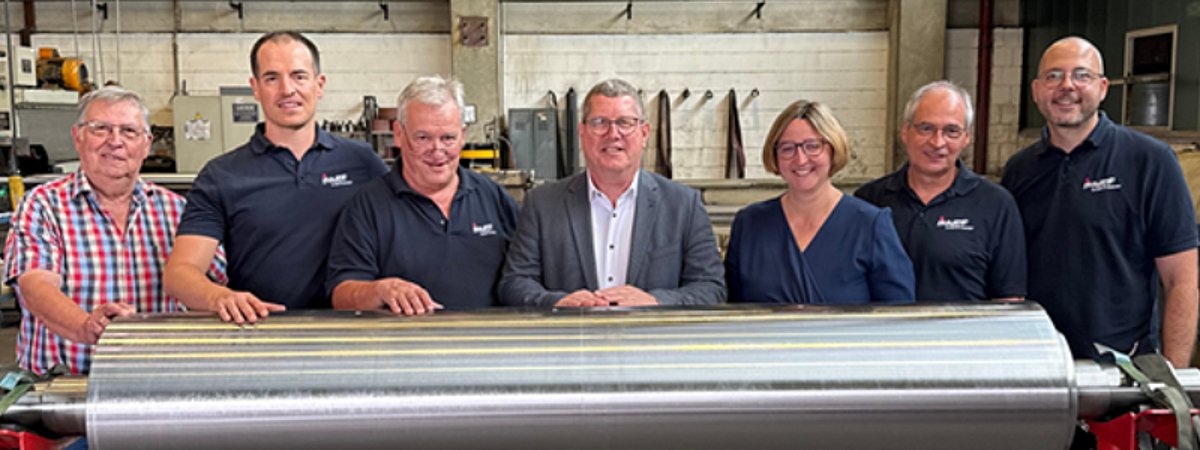
On July 27, 2026, Imhof Hartchrom welcomed Stefan Köhler, a member of the European Parliament, for a technical discussion on the current challenges facing surface engineering and the future viability of industrial production sites in Germany.
The focus of MEP Stefan Köhler’s company visit to Imhof Hartchrom GmbH was on the importance of functional hard chrome plating for a wide range of key industries, as well as the current discussion regarding the planned restriction on chromium trioxide, particularly the proposed drastic tightening of limit values. In addition, the measures the company has taken to date under the European REACH Regulation, along with their cost-benefit analysis, were described as a “journey into the unknown.” The company highlighted the wide range of applications for hard-chromed components and emphasized the need to take entire industrial value chains into account in future regulatory measures. Components with a hard chrome coating “Made in Karlstadt” are used, among other things, in mobile hydraulics, mechanical and plant engineering, the food industry, the printing and packaging industry, and in plastic injection molding machines.
Plant Tour with MEP Köhler at Imhof Hartchrom
During a joint tour of the facility, insights were provided into the production processes required to create a functional hard chrome coating. In addition, the extensive technical, organizational, and regulatory requirements associated with operating an electroplating facility and adhering to high environmental standards were explained. Köhler was impressed by the size of the components (feasible up to a component length of 10,000 millimeters) as well as by the wide variety of component geometries that can be coated with a functional hard chrome layer to achieve, among other things, higher wear resistance, excellent corrosion resistance, high surface hardness, and high temperature resistance. Furthermore, hard chrome coatings on components can also be economically and effectively remanufactured, thereby extending the service life of technical components. During the joint discussion, it was once again made clear that chromium trioxide remains indispensable for numerous industrial applications. Despite intensive research and development efforts, no alternatives are currently available for many areas of application that can guarantee all the necessary technical properties to a comparable degree.
Electroplating Companies Need Practical Operating Conditions
Representatives from both the second and third generations at Imhof Hartchrom jointly emphasized that protecting people and the environment is the company’s top priority. However, they also pointed out that companies need reliable and practical regulatory frameworks to maintain their industrial performance and competitiveness in the long term. Future regulatory requirements should be designed with technical feasibility and economic viability in mind. This applies not only to future regulations on chromium trioxide but also to PFAS regulations and the new IED Directive 2.0. Only in this way can industrial jobs and value creation in Europe be secured in the long term. In this context, the development of electricity prices—particularly for electricity-intensive companies such as electroplating firms—will also play an important role going forward. The two generations pointed out to Köhler that the uncertainty resulting from the REACH Regulation poses an additional challenge, especially for companies undergoing generational transition. Köhler expressed his gratitude for the opportunity to engage in an open and practical exchange on the challenges facing small and medium-sized industrial companies and the impact of European regulations on companies and their customers throughout the entire value chain. He also assured them that he would incorporate the insights gained and the suggestions from this constructive exchange into his future political work in Brussels.
Contact details and information on the companies and institutions presented here can be found in our interactive surface technology industry directory.