
Fraunhofer IWM Makes Post-Processing of AM Components Predictable
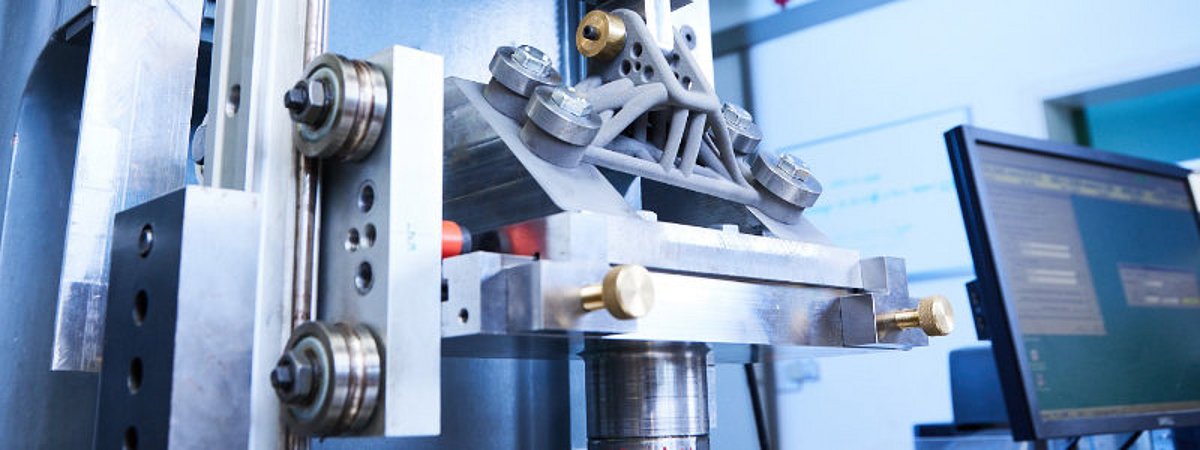
A new calculation method developed by Fraunhofer IWM enables the targeted design of mechanical surface treatments for additively manufactured metal components. In model tests, fatigue strength was increased by up to 40 percent.
Additively manufactured metal components offer great design freedom and a high degree of customization. However, in safety-critical applications—such as in the aerospace, automotive, or energy sectors—their use has often been hindered by insufficient fatigue strength. Surface roughness, residual tensile stresses, and microstructural defects such as gas pores or lack of fusion (LOF) act as crack initiators and can lead to premature component failure. Mechanical surface treatment methods such as shot peening, cold rolling, and smoothing can specifically reduce these weaknesses. They densify the surface layer, reduce the defect density, and introduce compressive residual stresses. Until now, however, there has been no practical computational model for their targeted application in AM components. Researchers at Fraunhofer IWM have now developed a model-based optimization strategy for this purpose. It is based on a fatigue life analysis according to the widely used FKM guidelines, which also takes into account the effects of surface post-treatment.
Post-Treatment Increases Fatigue Strength of AM Components
As part of a project funded by the Federal Ministry for Economic Affairs and Energy, the calculation chain was validated for the AM materials AlSi10Mg, 316L, and Ti6Al4V, as well as the manufacturing processes Laser Powder Bed Fusion (LPBF) and Cold Metal Fusion (CMF). Depending on the component geometry and the location of the most heavily stressed areas, the appropriate post-processing method is first determined. A process simulation then predicts surface layer properties such as residual stresses, surface roughness, and work hardening as a function of parameters such as beam pressure, contact pressure, or track overlap. The service life assessment is based on the FKM guidelines adapted for the printed and post-treated materials. In model tests, fatigue strength was increased by up to 40 percent and service life was extended by several decades. The results were validated through fatigue experiments at the specimen and component levels. The method can already be used in the pre-development phase and enables the computational comparison of different post-processing strategies before the first component test takes place. Since components predominantly fail starting from the surface, a customized post-processing treatment can also partially compensate for process-related variations in the AM printing process.
Contact details and information on the companies and institutions presented here can be found in our interactive surface technology industry directory.