
Fraunhofer IST Awarded the 2026 Joseph von Fraunhofer Prize
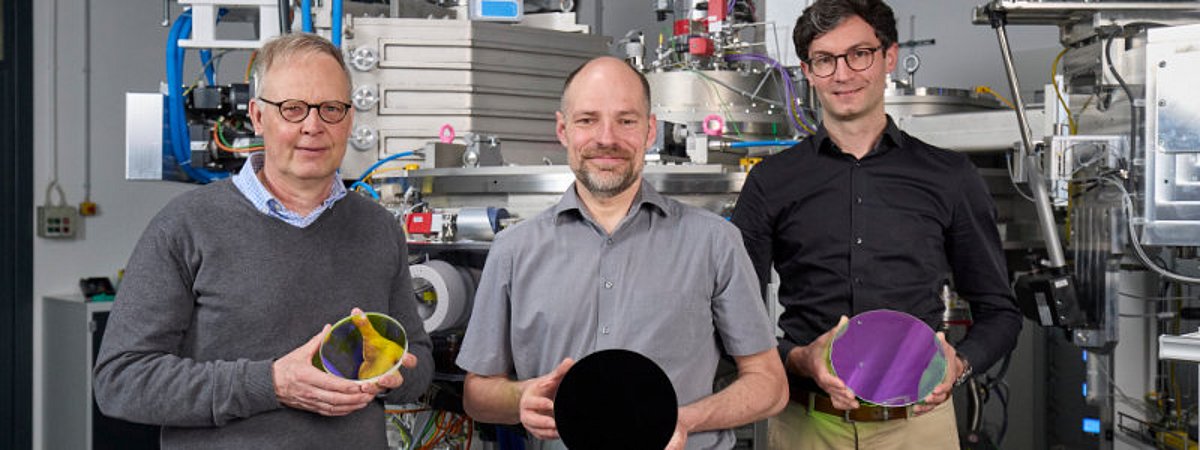
Researchers at the Fraunhofer Institute for Thin Film and Surface Technology IST were awarded the 2026 Joseph von Fraunhofer Prize for an innovative coating technology for precision optics that is already in industrial use.
The Fraunhofer IST research team has ushered in a new era in precision optics with the development of the Eoss (Enhanced Optical Sputtering System) production system. “Our shared goal was to make the production of high-precision optical coatings industrially scalable, efficient, and flexible. With the Eoss production system and the complementary control and monitoring software Mocca+ (Modular Optical Coating Control Application), we have succeeded in translating scientific excellence into an industrial product that sets global standards. The fields of application range from autonomous driving and medical technology to smartphone optics, telecommunications, and aerospace,” explains Dr. Michael Vergöhl, head of the Optical and Electronic Systems Department at Fraunhofer IST and the scientific driving force behind the project. He has been pursuing the vision of revolutionizing the industrial use of precision optics since 2012.
Unique EOSS Coating System
For the first time, the EOSS system utilizes rotatable double-tube cathodes, known as rotatable magnetrons. In combination with novel mixed targets made of metal and metal oxide, this enables a reactive-gas-free and extremely stable coating process. The spatially separated plasma after-reaction and the upward-facing, low-particle design ensure that even the most demanding optical components can be manufactured uniformly and reliably. Another technological breakthrough is the simultaneous double-sided deposition of optical coatings. “The ability to coat both sides simultaneously doubles productivity and enables the coating of very thin substrates with maximum process stability and uniformity—something that was previously unthinkable,” explains Dr. Michael Vergöhl. The production system’s performance data is impressive: Extremely high and stable uniformity levels close to 100 percent are maintained over a production period up to ten times longer than with previous systems. This, combined with the ability to create reproducible gradient profiles and the high degree of automation, demonstrates the technology’s industrial maturity. The hardware is complemented by Mocca+, a modular, model- and data-driven control and monitoring software that consolidates process control, data acquisition, and analysis. Mocca+ enables real-time monitoring of the entire coating process—a first in industrial production.
Contact details and information on the companies and institutions presented here can be found in our interactive surface technology industry directory.