
Fraunhofer ISE opens laboratory for perovskite silicon photovoltaics
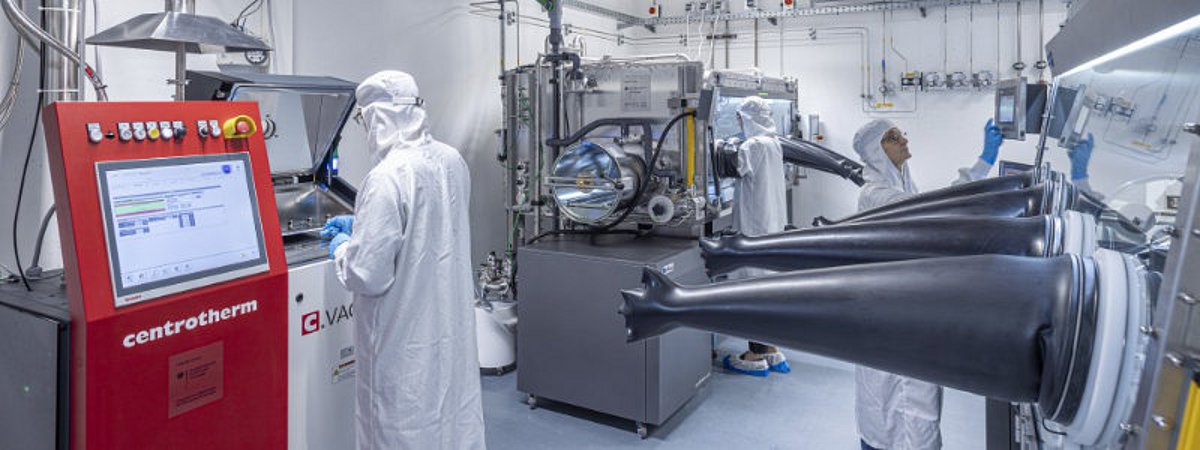
With the new "Pero-Si-Scale" laboratory, Fraunhofer ISE aims to accelerate the industrial introduction of perovskite silicon tandem solar cells. The infrastructure supports scaling to large cell formats and is intended to strengthen the competitiveness of European photovoltaics.
The Fraunhofer Institute for Solar Energy Systems ISE has opened a new research and development center for perovskite silicon tandem solar cells. The aim of the "Pero-Si-Scale" laboratory is to accelerate the transition from laboratory development to industrial production and to provide manufacturers in Germany and Europe with an independent infrastructure for the development and scaling of new photovoltaic technologies. Perovskite silicon tandem solar cells are considered a promising approach for further increasing efficiency in photovoltaics. By combining a perovskite layer just 500 nanometers thick with a conventional silicon solar cell, the theoretical efficiency limit increases from 29.4 to 43.3 percent. In the new laboratory, solar cell and module manufacturers can transfer new cell concepts to industry-related processes, develop large-format cell architectures up to wafer sizes of 210 × 210 millimetres, analyze them comprehensively and integrate them into modules.
Scaling perovskite silicon tandem cells for industrial production
The Pero-Si-Scale closes the gap between early research and industrial implementation. The infrastructure is based on developments of technology maturity levels TRL1 to TRL4 and transfers these into high-throughput manufacturing processes. In addition, extensive analysis and characterization options are available. Fraunhofer ISE relies on the so-called hybrid route, which combines vacuum and wet-chemical processes. With this process, efficiencies of over 33 percent have already been achieved on a laboratory scale. One advantage of this approach is that established, textured silicon solar cells from existing production lines can still be used. This should facilitate integration into existing production structures and increase the energy yield of future modules. According to the institute, perovskite silicon tandem solar cells could also provide new impetus for stronger European photovoltaic production. In view of the ongoing competitive pressure on the solar industry, the new infrastructure should help to translate research results into marketable technologies more quickly.
Contact details and information on the companies and institutions presented here can be found in our interactive surface technology industry directory.