
Spectaris Association criticizes planned PFAS restrictions
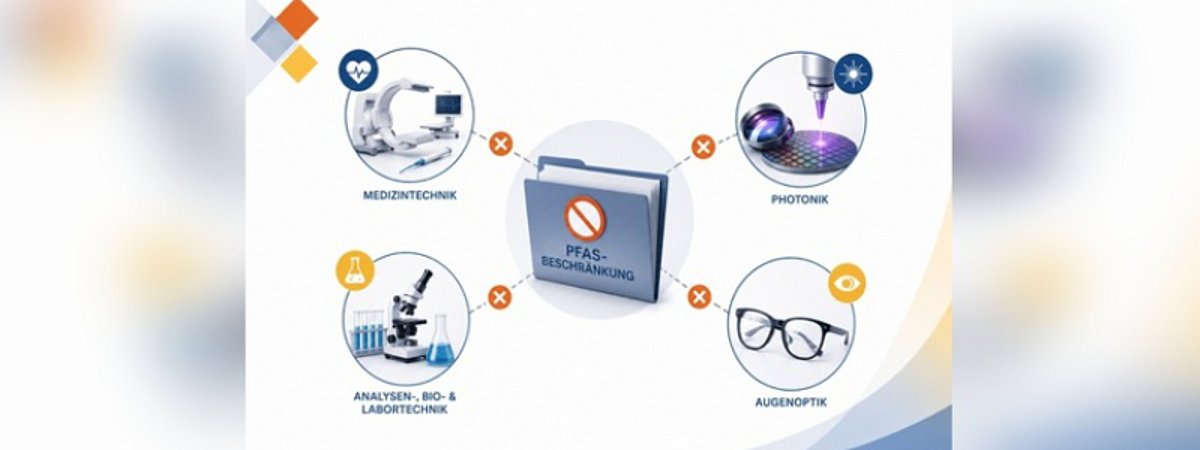
The German industry association Spectaris warns of the far-reaching consequences of the planned PFAS restriction for medical technology, photonics and analytical, bio and laboratory technology. Functional coatings for spectacle lenses, for example, could have a significant negative impact.
As part of the latest SEAC consultation of the European Chemicals Agency (ECHA), Spectaris has submitted four statements for its affected sectors and is in favor of a substance-related, risk-based regulatory approach and appropriate exemptions. According to the association, the proposed blanket regulation of more than 10,000 PFAS substances does not do justice to the technological reality of many high-tech applications. Spectaris is particularly critical of the lack of preferential treatment for fluoropolymers. These are indispensable in numerous industrial applications; in many cases there are currently no technically equivalent alternatives for them, and so far no unacceptable risk has been demonstrated - actually a requirement of the REACH regulation for a restriction.
Effects on functional coatings due to PFAS restrictions
In photonics and semiconductor technology, PFAS are used in highly sensitive production processes, coatings, special optics and cleanroom and laser applications, among other things. Spectaris believes that there is a risk of significant disadvantages for key European technologies and international competitiveness. The ophthalmic optics industry, for example, uses PFAS in particular for functional coatings on spectacle lenses, which enable properties such as high durability, easy cleanability and water-, oil- and dirt-repellent surfaces. Current analyses show that these applications can be classified as low-emission overall and that the additional environmental benefit of a ban would be comparatively low. At the same time, there is a risk of significant negative effects on product quality, consumers, innovative capacity and the competitiveness of European manufacturers of ophthalmic products, as there are currently no equivalent alternatives with comparable performance and long-term stability available. According to current socio-economic assessments, this could result in shortened product lifetimes, increasing consumer burdens, market distortions due to imports that are difficult to control and significant job losses. "The proposed PFAS restriction already overshoots the mark in principle. Europe does not need a blanket ban, but a restriction approach for substances whose critical emissions into the environment cannot be avoided. This is another reason why we reject a restriction on fluoropolymers for which no relevant risk is identifiable and demonstrable," explains Jörg Mayer, Managing Director of Spectaris.
Contact details and information on the companies and institutions presented here can be found in our interactive surface technology industry directory.