
Fraunhofer IPT: New process chain for functionalized thin glass
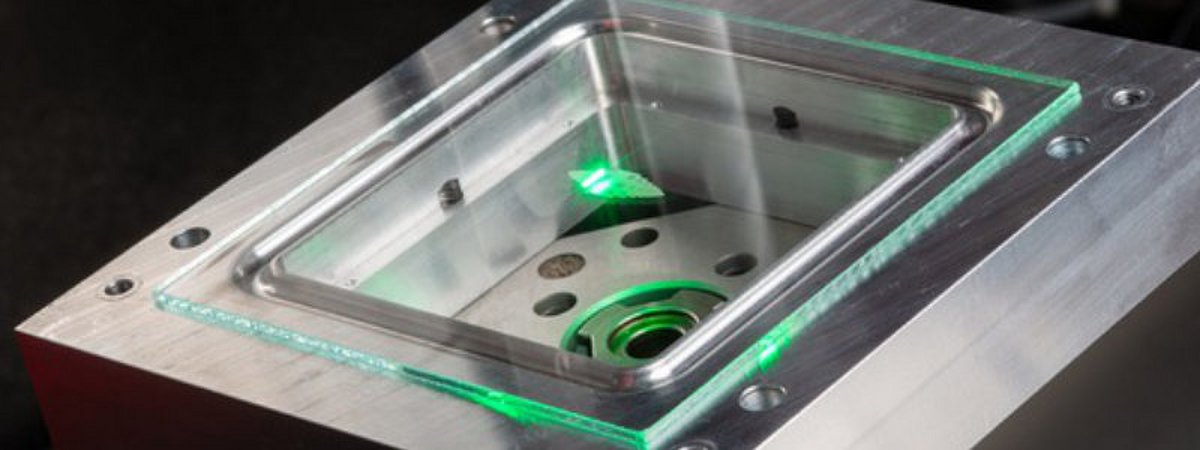
Together with project partners, Fraunhofer IPT has developed a process chain for the production of 3D thin glass with a functionalized surface. The process chain combines laser structuring with subsequent forming and reduces energy requirements and CO₂ emissions.
Thin glass can be used in a variety of ways. Chemical structuring and replication by molding are currently used for the surface structuring of thin glass, but these have disadvantages such as environmentally harmful etching agents. In the research project "EffF3D - Efficient functionalization of 3D-formed thin glass", the Fraunhofer IPT has developed and tested various process chains for the mass production of complex-shaped, functionalized thin glass. They consist of two steps: the structuring of flat glass blanks with an ultrashort pulse laser (USP laser) and the subsequent forming. The flat glass blanks are structured using the USP laser and pulse durations of less than ten picoseconds. Due to the low heat input, the material is processed particularly gently and optically and haptically effective micro- and nanostructures can be created on glass. The project team tested two complementary processing concepts. In one, the laser beam is directed via two motorized mirrors. The mirrors are constantly accelerated and decelerated, which limits the processing speed. In the second method, on the other hand, the beam is deflected by a very fast rotating mirror with many small facets. This continuous rotation allows the laser to process large areas in a very short time. With both configurations, the researchers were able to create anti-glare, anti-reflective and anti-fingerprint structures.
Glass forming: comparison of different processes
In order to form the structured glass blanks, the researchers compared two variants of hot forming: isothermal and non-isothermal forming. In the isothermal process, the tool is heated together with the glass. This process achieves particularly high shaping accuracy, but the cycle times are very long. Non-isothermal process control, which was developed at the Fraunhofer IPT, separates the heating, forming and cooling steps. The glass blank is first placed on a preheated forming tool and then moved into the furnace. Due to its lower mass, the glass heats up faster than the forming tool and is formed. The hot glass is then removed from the mold and cools down outside the mold. The mold is immediately available for the next cycle. In this way, cycle times of less than 100 seconds per component can be achieved.
Digital process monitoring and compensation of structural distortions
In the "EffF3D" project, various sample components, including functionalized center consoles and windscreens, were manufactured on near-series systems. As pre-structured glass blanks were formed in this way for the first time, determining the optimum process temperature was a key challenge: it must be high enough to enable shaping, but must not affect the microstructures introduced in an untargeted manner. The researchers used various sensors, such as temperature sensors, to monitor the process. The previously introduced microstructures change as a result of the forming process. To ensure that the structures still have the desired shape and position at the end, the researchers have developed a compensation method that uses computer simulations to calculate the expected distortions in advance. These distortions are taken into account when structuring the glass blank so that the correctly shaped structures are in the right place after forming. When analyzing ecological criteria such as energy and material requirements, the combination of laser structuring and non-isothermal forming turned out to be very efficient in terms of CO₂ emissions. As both processes - laser scribing and non-isothermal forming - are operated entirely electrically, the respective CO₂ emissions depend directly on the electricity mix used and will continue to fall as decarbonization progresses.
Contact details and information on the companies and institutions presented here can be found in our interactive surface technology industry directory.