
Adphos Builds Pilot Plant System for Drying Battery Electrodes
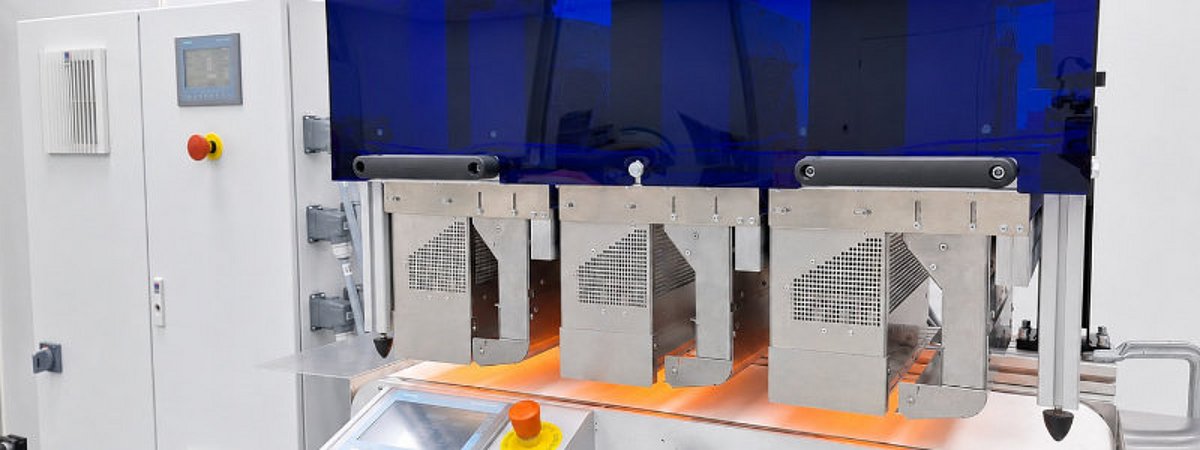
Adphos is installing a pilot plant system in Japan for the ultra-fast drying of battery electrodes. The BearLITE pilot plant system enables real-world testing of NMP-based cathode coatings and water-based anode coatings.
The Adphos Group has successfully installed a BearLite pilot system for the ultra-fast drying of wet-coated battery electrodes at a Japanese engineering and consulting firm that is a partner of Adphos. The installation enables the evaluation of modern drying processes for NMP-based cathode and water-based anode coatings under real-world conditions. The drying of coated battery electrodes is one of the most energy-intensive, space-intensive, and cost-intensive process steps in cell manufacturing. At the same time, it has a major impact on the quality of the electrode coating. BearLite differs from conventional hot-air drying primarily in the type of energy input: the photonic energy acts directly on the wet slurry layer and enables homogeneous volumetric heating across the entire layer thickness. The liquid or solvent vapors that form very rapidly during this process are controlled and removed from the process via a locally integrated exhaust system. In this way, BearLite combines drying times in the range of seconds with a process control system that—as demonstrated in numerous tests—enables crack-free coatings and prevents binder migration.
Drying of Battery Electrodes at an Automaker
As part of the on-site tests, several water-based anode and NMP-based cathode formulations were examined, including formulations from a leading Japanese automaker. Wet film thicknesses of up to 500 µm were dried within approximately 15 to 30 seconds. The final residual moisture was less than 0.1%. At the same time, crack-free coatings and no binder migration were once again observed. The Japanese partner is now investing in a BearLite-based pilot line and is evaluating the economic potential for future mass production of battery electrodes. The focus is on potential savings in operating costs as well as a significant reduction in CAPEX-related expenses for dryer infrastructure, utility supply, and production facilities.
Testing BearLite Technology Under Real-World Conditions
“For us, the installation in Japan is an important step toward further developing BearLite under demanding, real-world conditions,” says Dr. Kai K. O. Bär, CEO and CTO at Adphos. “If drying time, energy consumption, and plant footprint can be significantly reduced without compromising coating quality, manufacturers gain greater flexibility in plant design and in scaling up battery electrode production.” BearLite now offers battery manufacturers, equipment builders, and materials developers the opportunity to reassess the space requirements, energy consumption, and costs associated with electrode drying. The existing systems in China and South Korea, the installation in Japan, and further activities in Taiwan demonstrate that BearLite is increasingly being evaluated under real-world market and production conditions. Adphos thus underscores that BearLite is not a concept, a laboratory approach, or an early-stage pilot idea, but a real-world application with proven TRL-8 validation.
Contact details and information on the companies and institutions presented here can be found in our interactive surface technology industry directory.